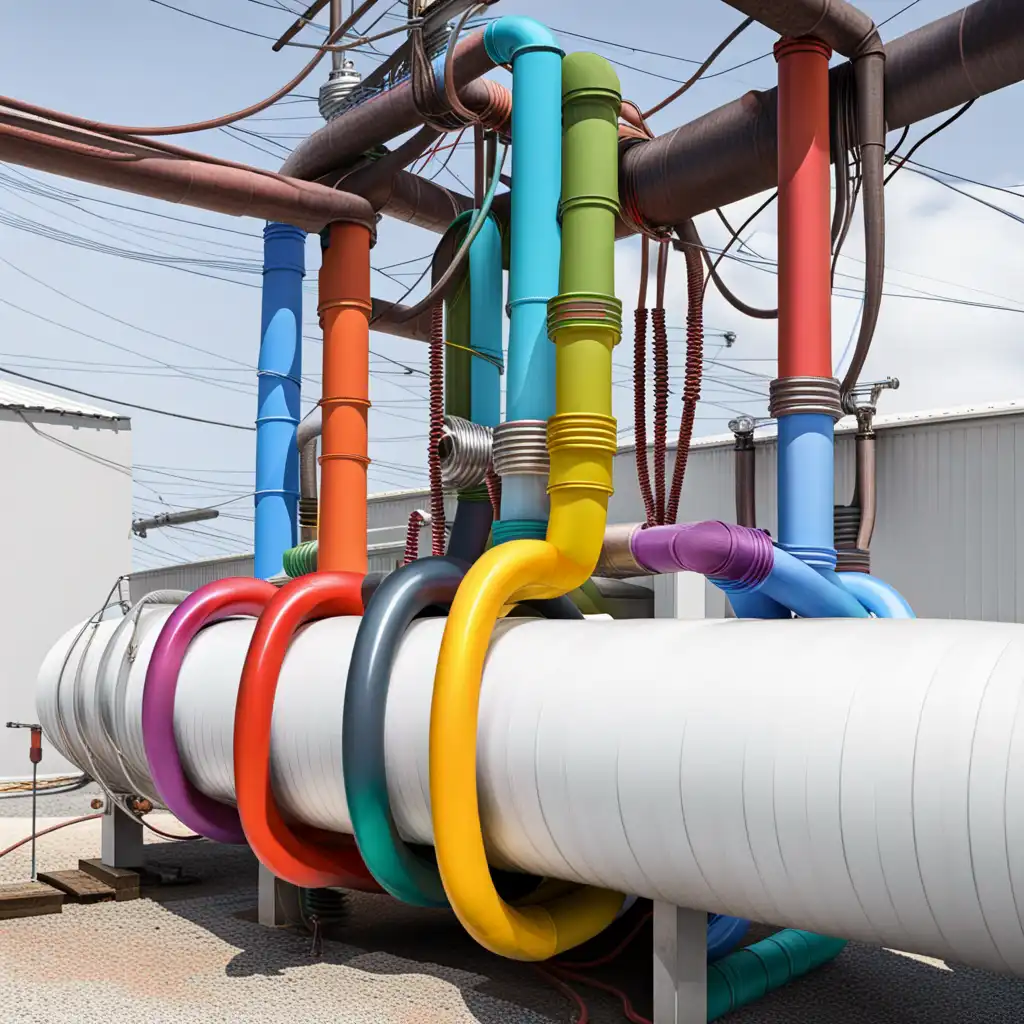
conduit
noun conduit
ˈkɑːnduɪt
A tube or pipe that protects electrical wires or carries liquids or gases.
The plumber installed a conduit to transport water from the roof to the storage tank.
conduit
ˈkɑːnduɪt
Chargement…
ˈkɑːnduɪt
A tube or pipe that protects electrical wires or carries liquids or gases.
The plumber installed a conduit to transport water from the roof to the storage tank.
ˈkɑːnduɪt
Someone or something that serves to direct or transmit something.
The organization acts as a conduit for the fund distribution to local communities.
Impossible de charger l’audio. Réessayez plus tard.
A conduit is a channel or a pathway that allows something, like water or electricity, to flow through. It can also refer to a person or organization that helps to facilitate communication or transmission of information between two parties. For example, an electrical conduit is a tube that directs electrical wires from one location to another. A teacher can be a conduit between parents and students, relaying important information and ensuring that both parties understand each other's needs.
An aqueduct is a large man-made structure, typically made of stone or concrete, that carries water over long distances.
An aqueduct is a large structure for transporting water over long distances, while a conduit is a smaller pipe or channel for transporting water over shorter distances.
Ouvrir le mot: Aqueduct →A channel is a medium through which something flows, like a river channel or a television channel.
It is often used in the context of broadcasting or communication, as in a channel for transmitting information. It also refers to a pathway or route, like a channel for navigation.
It can also refer to a person who channels or transmits something, like a conduit of information.
A channel is more general and can refer to any medium or pathway for conveying something, while a conduit is a specific kind of pathway or delivery system.
Ouvrir le mot: Channel →Both conduit and conveyance refer to a means of transporting something from one place to another.
However, conduit generally refers to a tube or pipe that carries fluids, such as water or gas, while conveyance can refer to any mechanism that moves something, such as a conveyor belt or transport system.
In practical terms, conduit is used more often in plumbing and electrical contexts, while conveyance is used more broadly, such as in transportation or industrial processes.
Ouvrir le mot: Conveyance →A duct is typically used to move air or other gases. Ducts are usually made of metal and can be found in heating, ventilation, and air conditioning (HVAC) systems or as exhaust pipes for vehicles.
So, in summary, conduits protect and route materials like wires or cables, while ducts move air or gases.
Ouvrir le mot: Duct →A conduit is a pipe or channel used for conveying water or other fluids, while a groove is a narrow channel or depression in a surface.
Grooves are used in a variety of contexts, such as in music where a groove refers to a rhythmic pattern. They can also refer to the grooves on a vinyl record, the grooves on a tire to help with traction, or the grooves on a tool for gripping and manipulating objects.
Overall, conduits are more specific to fluid transportation, while grooves have a wider range of applications.
Ouvrir le mot: Groove →A conduit is a specific type of passage that is used to channel or transport something like water or electricity.
A passage is a general term that refers to any type of pathway or route that can be used to access another area or room.
A passage can be anything from a hallway or corridor to a narrow gap between rocks or walls.
A conduit is a specific type of passage that is designed to channel or transport something, while a passage refers to any type of pathway or route that can be used to access another area or room.
Ouvrir le mot: Passage →Pipes and conduits are both used to transport materials, but there are differences between them.
A pipe is a hollow cylinder made up of metal, plastic, or any other material.
It is usually used to transport liquids or gases. For example, pipes are used to transport water or natural gas in households.
A conduit is a type of pipe used to protect electrical or communication cables.
In summary, pipes are used to transport liquids or gases, while conduits are used to protect electrical or communication cables.
Ouvrir le mot: Pipe →A pipeline is used to transport liquids, gases, or other substances over long distances. This can include things like oil, gas, water, or chemicals.
Pipelines are typically made of metal or plastic and are buried underground or placed above ground.
So, while a conduit is used to protect wires, a pipeline is used to transport substances. Conduits are typically used in buildings or for short distances, while pipelines are used to transport substances over longer distances, such as across states or countries.
Ouvrir le mot: Pipeline →A trough is similar to a conduit, but is usually wider and flatter in shape. Troughs are used to carry liquids or granular materials, like coal or grain.
A conduit is more narrow and often used for guiding something along a specific path, while a trough is wider and typically used for carrying or moving larger volumes of material.
Ouvrir le mot: Trough →Both conduit and tube refer to a cylindrical structure used for containing and directing things through it.
However, conduit is typically associated with electrical wiring or cables while a tube can be used for a broader range of applications like fluid transport, air conditioning, or structural support.
In simpler terms, conduit is used for containing electrical wires, while tube can be used for anything from liquids to gases.
Ouvrir le mot: Tube →can travel to a healthy plant and prompt it to turn on its immune system too. These advance warnings increase the plants chance of survival. Bean plants also eavesdrop on each other's health through these fungal conduits. An aphid investation in one plant
Voir sur YouTube ↗I'm very much an observer and a conduit of thoughts and ideas.
the solution to the crisis of visual theft, if language really is the conduit of our cooperation, the technology that our species derived to promote the free flow and exchange of ideas, in our modern world,
Voir sur YouTube ↗Music as a social conduit has always been important to me.
transformations hoping to make the world a better place reasons for youth participation and movements vary compared to adults youth often have larger social networks which can serve as conduits for the
Voir sur YouTube ↗You need to be invested in what happens. The characters are your conduit to the story. Many modern horror films are fun but not frightening because one has not connected with the characters.
websites where we're from the rocky rough oak and I think people really don't want to be on H they really want to be able to end their own living there just isn't a conduit for them to do it
Voir sur YouTube ↗I would hope that, for me, regardless of what happens in my career in the future, I always want to maintain a level of humility. I think it's so important to not lose yourself and to just understand that you're a conduit.
draining waste in water conduits below. Today most cultures consider trips to the restroom to be a more private occasion. But even when going alone our shared sewage infrastructure is one of the most pivotal inventions in the history of humanity.
Voir sur YouTube ↗You're not really necessarily the coolest guy in their life. You are a conduit to the really cool people.
Represented in Taino carvings and figurines with a swollen back and emaciated arms, the caracaracol is both cursed and blessed to be a conduit between worlds.
Voir sur YouTube ↗Trust comes before strength, and it becomes a conduit of influence. Your strength is a little bit threatening before people trust you.
almost immediately. One of the most important things about comics that I discovered was that comics are a visual medium, but they try to embrace all of the senses within it. So the different elements of comics like pictures and words, and the different symbols and everything in between that comics presents, are all funneled through the single conduit a vision.
Voir sur YouTube ↗When I get to do whatever I want, I'm perfectly happy. I've found that the best scenario is that I just do what I do, and if somebody wants to be part of it, they should work as a conduit for what vision I have. They should help me complete the universe.
Caves form in karstic regions. So karstic regions are areas of the world where the infiltrating water along cracks fractures, can easily dissolve soluble lithologies, forming a drainage system of tunnels conduits --
Voir sur YouTube ↗I sort of feel like my job is to be a conduit to opportunities, to maximize the creativity of the day itself - because that's when the cameras are running. That's the important thing to me. Some of these shots you need to think about in advance; you need to have some ideas for them.
I kind of became a conduit for all of this courage that was given to me. And I think that's part of our job as artists. I think we should be conveyors of courage in the work that we do. And I think that we are the wall between the normal folks
Voir sur YouTube ↗There are documentaries that will just save your life and be the conduit to the art form you started out loving.
are related because survival is all about the relationship between a creature and everything else the outside world predators prey potential mates the eye is one of the most complex conduits between those two things the outside world and the creature who knots not
Voir sur YouTube ↗The Internet has been this miraculous conduit to the undeniable truth to the Holocaust.