
olfactory
adjective olfactory
ɑːlˈfæktəri,əʊlˈfæktəri
Related to the sense of smell
The olfactory system plays a critical role in taste.
olfactory
ɑːlˈfæktəri,əʊlˈfæktəri
लोड हो रहा है…
ɑːlˈfæktəri,əʊlˈfæktəri
Related to the sense of smell
The olfactory system plays a critical role in taste.
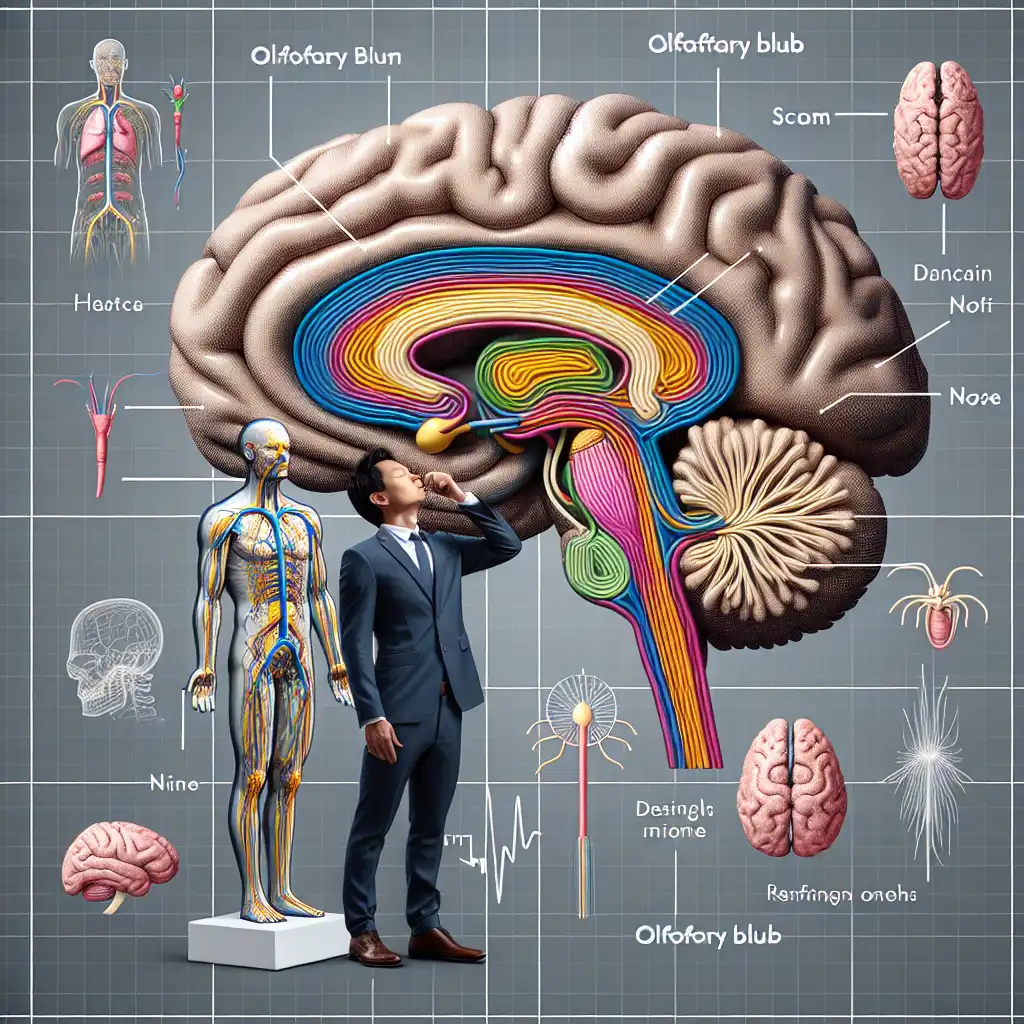
ɑːlˈfæktəri,əʊlˈfæktəri
Part of the brain that controls the sense of smell
Damage to the olfactory can hinder a person's ability to smell.
ऑडियो लोड नहीं हो सका। कृपया बाद में फिर कोशिश करें।
The word 'olfactory' is used to describe things that are related to smell or our sense of smell. For example, when we say that something has a strong odor, we are talking about its olfactory properties. It is a scientific term that is often used in fields like biology, environmental science, and medical research. If you are interested in these subjects, you will likely come across the word 'olfactory' frequently.
Aroma and olfactory are similar words used to describe scents or smells.
However, aroma is usually used in reference to something pleasant or desirable, such as the aroma of freshly baked bread or coffee.
Aroma is typically used to describe a specific scent, while olfactory is used more generally to describe anything related to the sense of smell.
शब्द खोलें: Aroma →Fragrance refers to a pleasant smell, typically of a perfume or a flower, while olfactory refers to the sense of smell itself.
Fragrance is applicable to describing the quality of a smell, while olfactory is applicable to the ability to detect smells through the nose.
In simpler terms, fragrance describes the way something smells, while olfactory describes our ability to smell it.
शब्द खोलें: Fragrance →Nasal refers to the nose or the nostrils, while olfactory refers to the sense of smell.
Nasal can describe things that are related to the nose, such as nasal congestion or nasal polyps.
Olfactory can describe things that are related to the sense of smell, such as olfactory receptors or olfactory memory. Nasal pertains to the nose while olfactory pertains to the sense of smell.
शब्द खोलें: Nasal →Odour refers to a smell or aroma, while olfactory refers to the sense of smell.
Odour can describe a specific scent, such as the odour of fresh baked cookies or the odour of gasoline.
Odour is a particular scent, while olfactory refers to the sense of smell.
शब्द खोलें: Odour →Olfactory refers to the sense of smell, while perfume refers to a scented liquid used to give a pleasant smell.
Olfactory can be applicable in describing anything related to our sense of smell, such as a perfume, a flower, or even an unpleasant odor like garbage.
Perfume is specifically applicable to scented liquids used to make people smell good. It is commonly used in personal care products and often associated with fragrance or cologne.
शब्द खोलें: Perfume →Olfactory refers to the sense of smell, while scent refers to a specific smell or perfume. For example, the olfactory nerves in your nose allow you to detect scents like the scent of flowers, coffee, or smoke.
Olfactory is a term used in relation to our sense of smell, while scent describes a particular smell or aroma.
शब्द खोलें: Scent →Olfactory refers to the scientific sense of smell, which involves the detection of odor molecules by sensory cells in the nose.
Smell is a more general term that can refer to both the scientific process of olfaction as well as the perception of scents by humans and animals.
It is more commonly used in everyday language. In simpler words, olfactory is a scientific term that refers to the process of smelling, whereas smell is a more general term that can refer to both the scientific process and our perception of it.
शब्द खोलें: Smell →Olfactory refers to the sense of smell, while whiff refers to a brief and faint smell or odor.
Whiff is applicable when describing a sudden, short-lived smell or scent.
It can describe a pleasant or unpleasant smell that is only briefly detected. For example, if you catch a whiff of someone's perfume or cologne as they walk by, you might describe it as a pleasant whiff of scent.
However, if you smell a foul odor for just a moment, you might describe it as a bad whiff.
शब्द खोलें: Whiff →and allow odor concentration to build up over mulitple sniffs. But all that impressive nasal architecture wouldn't be much help without something to process the loads of information the nose scoops up. And it turns out that the olfactory system dedicated to proessing smells
YouTube पर देखें ↗The identification of a population of olfactory sensory neurons innervating a single glomerulus that mediates robust avoidance to a naturally occurring odorant provides insight in the neural circuitry that underlies this innate behavior.
I like this example because it clearly demonstrates that an olfactory receptor's primary job is to be a chemical sensor, but depending on the context, it can influence how you perceive a smell,
YouTube पर देखें ↗Smell was our first sense. It is even possible that being able to smell was the stimulus that took a primitive fish and turned a small lump of olfactory tissue on its nerve cord into a brain. We think because we smelled.
olfactory cues scent-marking calling kangana sauce lion's roar obviously they completely have different lifestyles and I just think that's indeed very very fascinating leopards
YouTube पर देखें ↗Sweet peas should smell. Half the point of growing sweet peas is to cut them for the house; they should fill a room with an almost painful olfactory inarticulateness. But most sweet peas smell of nothing. This does not stop them being beautiful, but they are like food with no flavour.
the subventricular zone which may supply neurons to the olfactory bulb for communication between the nose and brain, and the striatum which helps manage movement. Scientists don't yet have a good grasp on exactly what role
YouTube पर देखें ↗The one thing that holds people back from working out together is that they don't want to smell around other people. Your olfactory sense is the primary sense in your memory, and you don't want to be part of anyone's memory thinking that you smell bad.
takes a direct route to these different regions of the brain, where it can trigger your fight-or-flight response, help you recall memories or make your mouth water. But even though we've all got the same physiological set-up, two nostrils and millions of olfactory neurons, not everybody smells the same things. One of the most famous examples of this
YouTube पर देखें ↗My childhood memories seem to be wreathed in the twin and far from harmonious olfactory sensations of patchouli oil and caustic soda.
matched our olfactory receptors." Though I'll probably also say something about her hair and personality as well. And that is a wonderful thing there. Love does not die because of that thing. Pain doesn't go away either. This is a terrible thing even though I understand pain.
YouTube पर देखें ↗man-made and natural scents are used as olfactory enrichment tools at the zoo the scents are sprayed inside animals enclosures to keep the animals active and engaged both for their mental and physical well-being and for the viewing
YouTube पर देखें ↗that lives in sub-saharan africa african pouched rats are among the world's largest rodents they can grow as long as 35 inches including the tail and they have a superpower that could save people's lives they do they have an amazing census mail great olfactory sense and that great old
YouTube पर देखें ↗long career as an archaeologist tom took the search for amelia one step further by enlisting the help of bone-sniffing dogs we humans with our defective eyesight and our even more defective olfactory abilities
YouTube पर देखें ↗there are some striking similarities. For example most insects have smell detectors on their antennae, similar to those found in human noses. And our primary olfactory brain regions look and function rather similarly, with clusters of neurons activated and deactivated in precise timing
YouTube पर देखें ↗