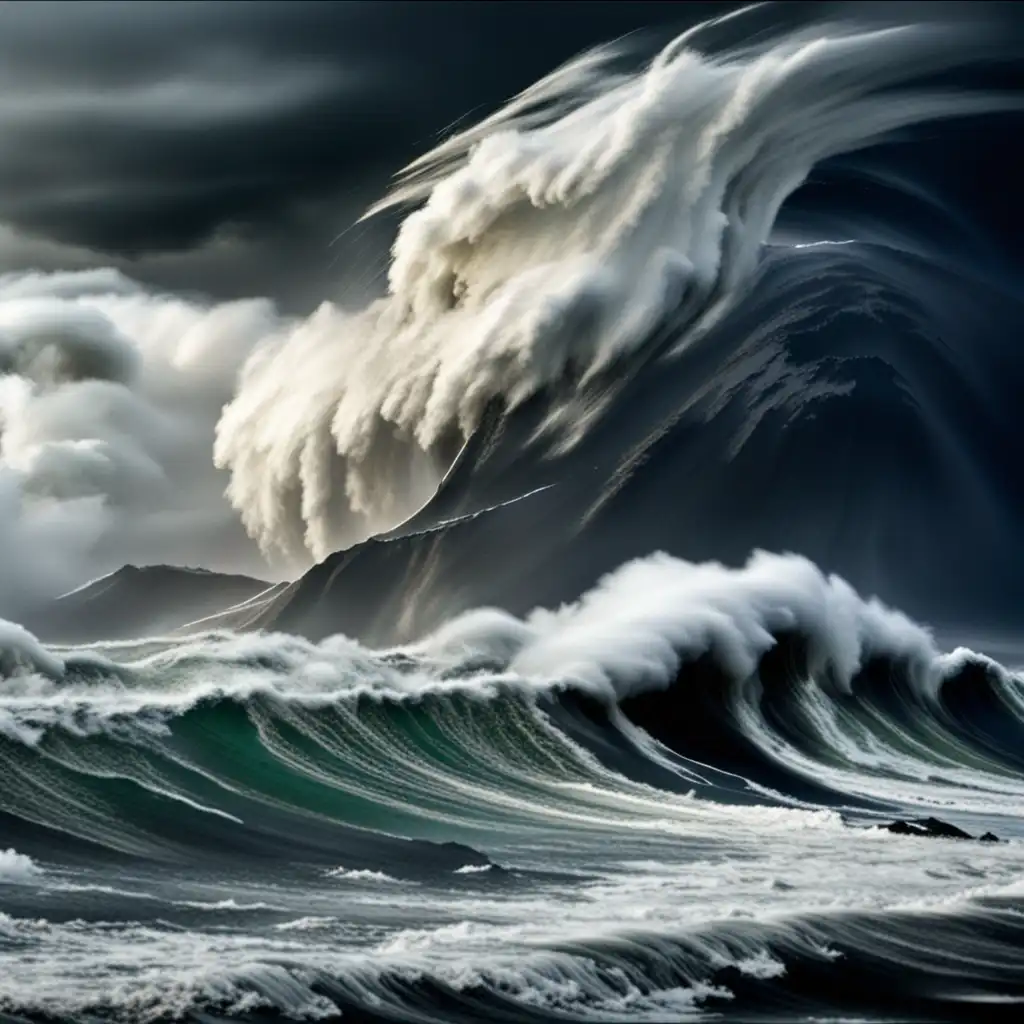
typhoon
noun typhoon
taɪˈfuːn
A strong, violent storm that happens mostly in the Pacific Ocean.
The typhoon caused a lot of damage to the coastal cities.
typhoon
taɪˈfuːn
Đang tải…
taɪˈfuːn
A strong, violent storm that happens mostly in the Pacific Ocean.
The typhoon caused a lot of damage to the coastal cities.
Không tải được âm thanh. Vui lòng thử lại sau.
A typhoon is a big storm that happens in the ocean near Asia. It's like a hurricane, but it's called a typhoon in that part of the world. When you hear people talking about a typhoon, they're usually talking about a very strong, very dangerous storm with a lot of wind and rain. If you hear a weather report saying that a typhoon is headed your way, you should be very careful and prepared for the storm.
Both cyclone and typhoon refer to a weather phenomenon that involves a rotating, low-pressure system with strong winds and heavy rain.
Cyclones primarily occur in the Indian Ocean and South Pacific Ocean, while typhoons are found in the Northwest Pacific Ocean.
Mở từ: Cyclone →Both gale and typhoon refer to strong winds, but there are some key differences between them.
A gale is a strong wind that typically occurs over the ocean or on land and has sustained speeds of 32-63 miles per hour (51-102 kilometers per hour).
A gale is a strong wind that can occur anywhere, while a typhoon is a much stronger wind specifically associated with tropical cyclones in the western Pacific Ocean.
Mở từ: Gale →The words hurricane and typhoon are both used to describe tropical cyclones or storms. The main difference is where they occur in the world.
A hurricane is a tropical cyclone that forms over the Atlantic Ocean or Northeast Pacific, while a typhoon is a tropical cyclone that forms over the Northwest Pacific.
If a tropical cyclone forms over the Atlantic Ocean or Northeast Pacific, it would be called a hurricane. Whereas if it forms over the Northwest Pacific, it would be called a typhoon.
Both hurricanes and typhoons have the potential to be very destructive and cause severe damage.
Mở từ: Hurricane →A squall is a sudden and brief burst of strong wind accompanied by rain or snow.
A squall is a sudden gust of wind in any location while a typhoon is a cyclone specific to the western Pacific Ocean region.
Mở từ: Squall →The main difference between storm and typhoon is their location. Storm is a term used to refer to a violent disturbance in the atmosphere that may cause strong winds, lightning, thunder, and even heavy rain or snow.
Essentially, it is the same weather phenomenon as a hurricane or a cyclone, but it occurs in the Pacific Ocean. Typhoons are often classified as some of the most powerful and destructive storms, with the ability to cause flooding, landslides, and extensive damage to buildings and infrastructure in affected areas.
Storm is a generic term used to describe any violent weather event, whereas typhoon is a more specific term used to describe a powerful tropical cyclone in the Western Pacific Ocean.
Mở từ: Storm →Tempest and typhoon are both words used to describe powerful storms, but they are different in several ways.
A tempest is a powerful and tumultuous storm that usually happens on land.
It can involve strong winds, heavy rain, thunder, and lightning. Tempests often occur in the spring and summer months.
A tempest is a storm that occurs on land and a typhoon is a storm that occurs in the ocean.
Mở từ: Tempest →The main difference between the words tornado and typhoon is the location where they occur.
A tornado is a rotating column of air that forms during a severe thunderstorm and touches the ground.
In summary, tornadoes occur over land and are associated with thunderstorms, while typhoons form over the ocean and affect countries in the western Pacific region.
Mở từ: Tornado →Whirlwind is a small and localized spinning column of air that rotates rapidly, picking up dust or debris in its path. It is applicable to describe a weather phenomenon that occurs for a short duration and is usually not as destructive as a typhoon.
Whirlwinds can be observed in arid regions or during thunderstorms.
Mở từ: Whirlwind →clean marvel at trees breathe air free of toxins these are natural rights not things that can be bargained for in Congress see they want you to feel powerless but it has been said that something as small as the flutter of a butterfly's wing can cause the typhoon halfway around the world will when
Xem trên YouTube ↗The direct risks from climate change are obvious: as changing weather patterns cause extremes of flood and drought, hurricanes and typhoons. These damage the physical infrastructure of buildings and bridges roads and railways. They are violent and disruptive.
Yet we do this because one life matters. Sometimes that's the only difference you make -- one individual one family a small group of individuals -- and it matters. When you have a tsunami an earthquake or a typhoon,
Xem trên YouTube ↗As a country in the path of typhoons and in the Pacific Rim of Fire, we must be prepared as the latest technology permits to anticipate natural calamities when that is possible, to extend immediate and effective relief when it is not.
access to savings and credit the right technical assistance and the ability to expand their home so but wouldn't all this be great if we prevented the disaster from happening if we strengthen buildings before the next earthquake or typhoon strengthening buildings in these
Xem trên YouTube ↗My father was executive officer, which is second-in-command, on a ship called the Hull, one of three ordered into a typhoon by Admiral Halsey - an insane and sadistic decision.
the white whale who bit off his leg. But though the book features pirates typhoons high-speed chases, and giant squid, you shouldn’t expect a conventional seafaring adventure.
Xem trên YouTube ↗We don't get typhoons in December. They normally end by September. A typhoon happening in October is considered a late event.
- Cyclone typhoon hurricane. All of these names are used around the world to describe the most powerful storm known to man.
Xem trên YouTube ↗My parents came from the Kyushu Island in the Southern part of Japan to find work in Tokyo. So we could only afford to live downtown, in a low-income area. It was just by the river, and whenever a typhoon came around, we were under water up to, like, here. That's the kind of place we lived in.
these are the hallmarks of a hurricane also called cyclones or typhoons hurricanes are giant storms prowling the world's tropical seas an average hurricane releases as much energy in a
Xem trên YouTube ↗Flying into a storm, even its outer edges, did not seem like a good idea to me. And this was no ordinary tempest. Everyone on the bridge knew what it was: the Devil's Fist, a near-eternal typhoon that migrated about the North Indian basin year-round. She was infamous, and earned her name by striking airships out of the sky.
more temperature right so we have locked in more floods more droughts more wildfires more typhoons so it's not a problem coming somewhere else in another generation it's coming to us now in our communities all around the world
Xem trên YouTube ↗In 1874, Mary Fraser accompanied her husband Hugh to Hong Kong, arriving hours after a typhoon had wrecked the island. Some 10,000 boat families had drowned in the harbour. There was no way to avoid the bloated bodies, and when Mary disembarked, she felt her foot land on something soft.
forcing many villagers to move inland or to nearby cities. Mohammadpur isn’t the only place where erratic weather is impacting people’s mobility. Repeated typhoons in the Philippines have displaced thousands from their homes.
Xem trên YouTube ↗Typhoon damage happens when they hit land, and as humans, we've decided to destroy mangroves and hurt coral reefs. If we don't have barriers, the devastation is worse, and that is scary.
and all the heat and cold and typhoons etc., there is nothing like it in the universe that we know of. Then let's turn Hubble in our direction, and let's look at the Earth. Let's start with the Amazon! Let's dive,
Xem trên YouTube ↗Typhoon Haiyan showed the entire world how vulnerable the Philippines as well as other developing countries are to natural disasters.
we are seeing stronger hurricanes typhoons and cyclones, powered by a warming ocean. If we live in Texas or if we live in Syria, we're seeing climate change supersize our droughts, making them more frequent and more severe. Wherever we live we're already being affected by a changing climate.
Xem trên YouTube ↗Nature did not gift us with a mighty Mekong like Thailand and Vietnam, with their vast and naturally fertile plains. Nature instead put our islands ahead of our neighbours in the path of typhoons from the Pacific.