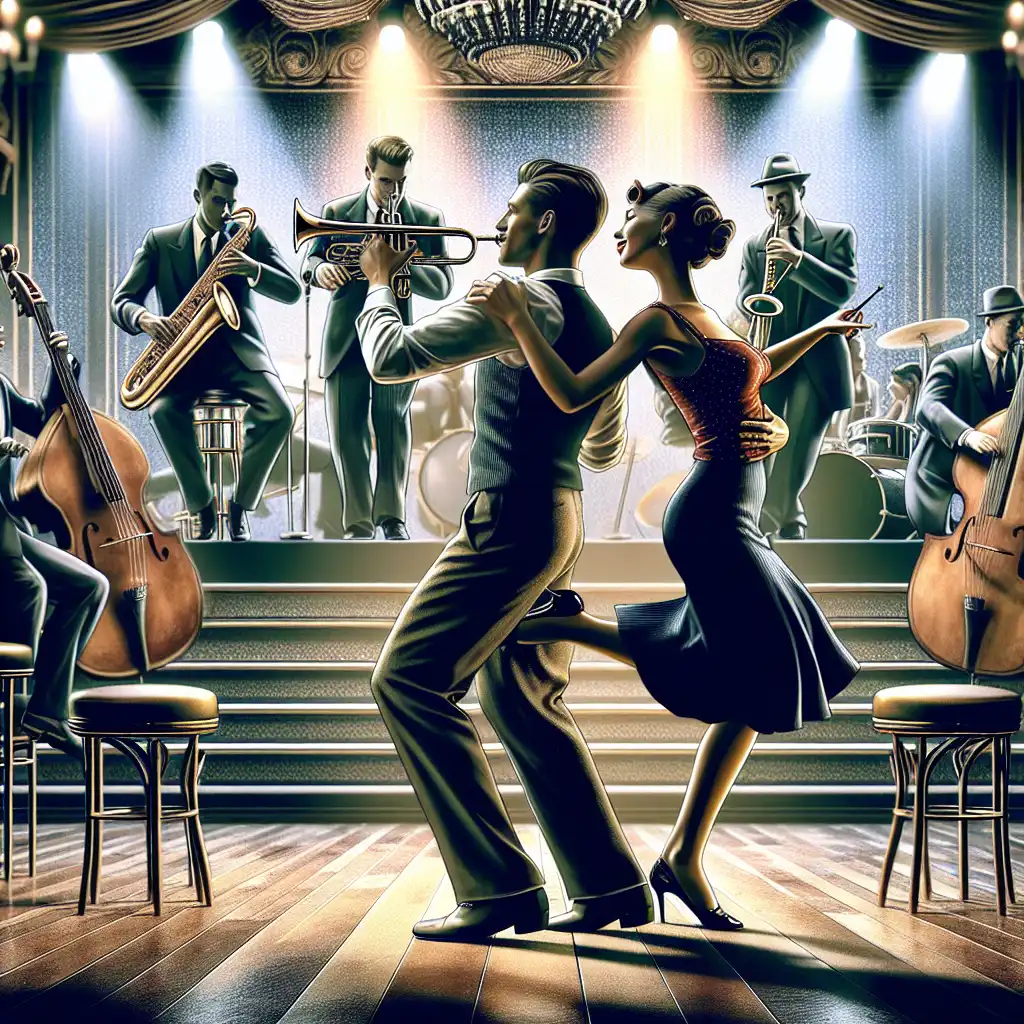
jive
noun jive
dʒaɪv
A style of fast and lively jazz or swing music
They danced to the jive played by the band
jive
dʒaɪv
불러오는 중…
dʒaɪv
A style of fast and lively jazz or swing music
They danced to the jive played by the band

dʒaɪv
To talk or write nonsense or misleading information
Don't jive me with your sweet talk

dʒaɪv
To dance the jive to fast lively music
They jived all night at the party

오디오를 불러오지 못했어요. 잠시 후 다시 시도해 주세요.
The word 'jive' is often used in American English to mean "to talk in a way that is meant to mislead or deceive someone." It is also used to describe a type of Swing dancing that was popular in the 1930s and 1940s. So, when using the word 'jive', it is important to understand the context in which it is being used to ensure that your message is clear.
Both boogie and jive are styles of dance that originated in the United States in the early 20th century.
Boogie refers to a type of swing dance that is typically performed to boogie-woogie music. It involves lots of hopping and bouncing movements, and is often danced in a closed position (with partners facing each other).
Boogie is also used more generally to describe any upbeat dance style that involves lots of body movement and footwork.
Boogie is a general term for an upbeat dance style, while jive is a specific form of swing dance characterized by fast footwork and energetic movements.
단어 열기: Boogie →Dance is a general term used to describe any type of movement performed in rhythm with music.
Jive is a specific type of dance that originated in African American communities in the 1930s.
It's a lively dance that incorporates fast footwork, syncopated rhythms and a lot of energy.
Jive is often danced to swing or rock and roll music.
Dance is a broad term encompassing many styles of movement to music, while jive specifically refers to a quick and lively partnered dance style.
단어 열기: Dance →Groove refers to a rhythm or beat that gets people moving or dancing.
In general, when we talk about groove, we are talking about the way music feels.
Groove is a musical term that describes the feel of a rhythm, while jive is a type of dance that is typically performed to swing music.
단어 열기: Groove →Jive refers to a specific dance style, typically associated with swing or jazz music. It involves lively steps and energetic movements with a lot of twists and turns.
Move is a broader term that simply means to change one's position or posture.
It can refer to any kind of motion, whether it's walking, running, lifting, or dancing. Both words can be used in a variety of contexts, but jive is specifically related to dancing, while move can refer to any kind of movement.
단어 열기: Move →Rhythm refers to the beat or tempo of a piece of music. It is the foundation of music, keeping time and structure, and can be found in all genres of music.
Jive is applicable in the context of dance, particularly in the style of swing dancing. Rhythm is a fundamental element of all music, regardless of style or genre.
단어 열기: Rhythm →Jive and rock are both words that refer to different types of music and dance.
Jive is typically danced to swing or rock and roll music and is often seen in ballroom dance competition.
Rock is a style of music that originated in the US in the 1950s and quickly became a global phenomenon. It is characterized by its use of electric guitar, bass, drums, and vocals.
Rock music usually features a 4/4 beat and is known for its energy, volume, and rebellious attitude.
Jive refers to a specific type of dance and music, while rock refers to a broader genre of music. Jive is typically danced to specific types of music, whereas rock can be danced to a wide variety of rhythms and beats.
If you're looking for loud, energetic music that you can dance to in your own style, then rock is the way to go.
단어 열기: Rock →Both jive and shuffle are types of dance, but they are different in how they are performed and the music they are danced to.
Shuffle is a dance that involves shuffling or dragging the feet in a particular rhythm, often to hip-hop or electronic music.
Jive is more formal and structured, while shuffle is more casual and improvisational. Whether you choose one or the other depends on the type of music and atmosphere you are dancing in.
단어 열기: Shuffle →Jive and Swing are both types of dance that originated in African American and African Caribbean communities during the 1920s-30s.
Swing is a more relaxed dance style that is characterized by a syncopated rhythm. The dance style evolved from jazz music and has a lot of improvisation, where dancers can add their own movements and flourishes.
There are several variations of swing dance, including the Lindy Hop, Charleston, and East Coast swing.
Jive is a high-energy dance with a lot of kicks and twists, while swing is a freestyle dance with a syncopated rhythm. Jive is more popular in ballroom dance competitions, while swing is often seen in social dance settings.
단어 열기: Swing →Ricardo Semler: Radical...
YouTube에서 보기 ↗I would say things like 'I am the greatest! I'm pretty! If you talk jive, you'll drop in five! I float like a butterfly, sting like a bee! I'm pretty!' When white people heard me talking like this, some said, 'That black man talks too much. He's bragging.
Polar Bear vs. Ring Seal...
YouTube에서 보기 ↗One of the great things about being recognized is that you receive this feedback from people. It is easy to see how sincere people are. It's nothing fake or jive. They're giving sincere appreciation. And it's not that easy to express.
I think it's important to cultivate as many people as you can to see which ones you jive with. And it makes you happy. If one dies, you have another one. So living is a process that you have to do by yourself, and if you can learn a few little goodies along the way that might make it easier for you, so much the better.
John Cena is one of the great WWE talents that I respect most. If I were to end up there, working with someone of his caliber would certainly be a goal and jive with my mission of changing wrestling.
There are dances you can do separately - your charleston, your jive.
I thought the Charleston would be a bit like the jive, but it isn't really.
Jive has been really, really good to me.
Jive is a good label, but they're R&B'ed out.
Sometimes when you're a songwriter, you kind of have this egotistic thing: you just want to write something that you love, and you don't care about if people like it or not, but personally, I want to write something that people can jive to.
The problem is that music is selfish in that you need to make it for yourself, so that you can give it away, and those two things don't jive. I needed to find the right reason to play that had the magic and mystery and excitement that made me want to play in the first place.