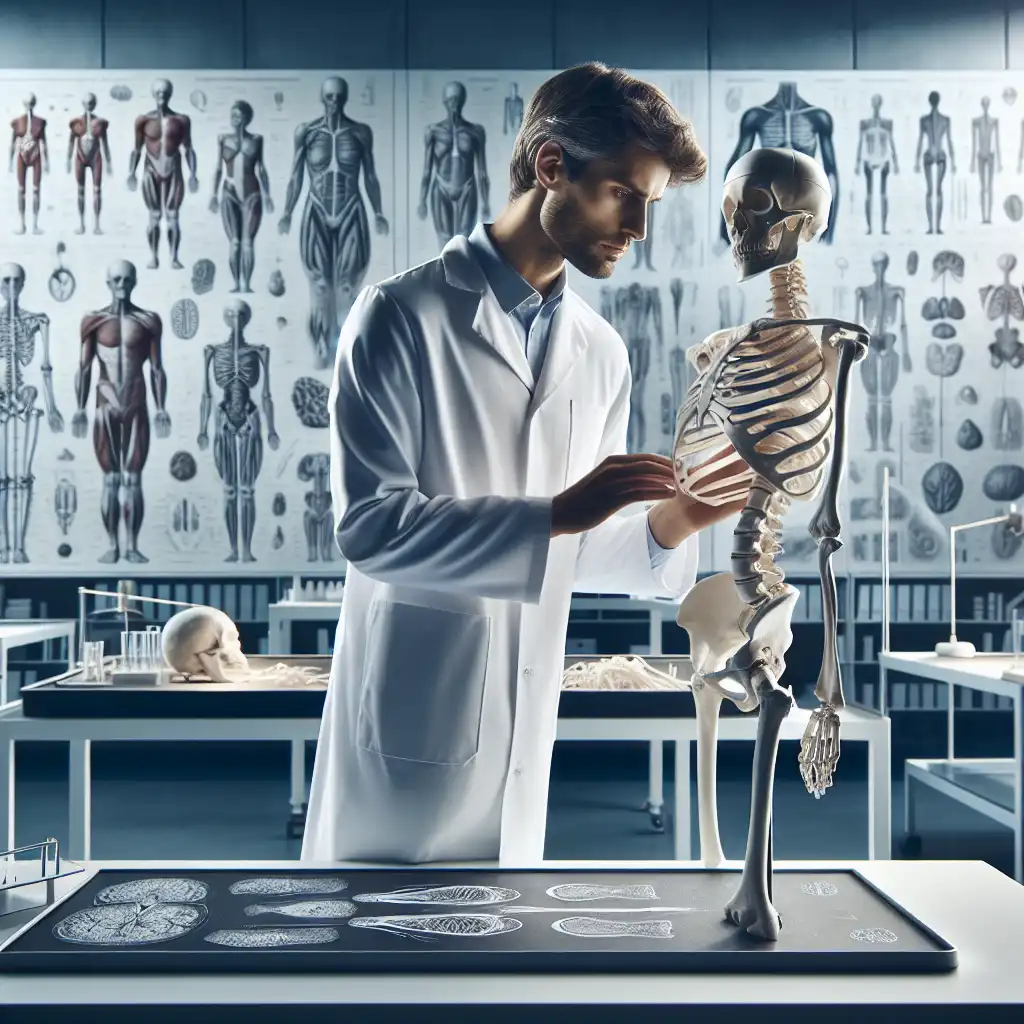
A person who studies or teaches the science of anatomy, the science that studies the structure of organisms including their systems, organs, and tissues.
The anatomist conducted a detailed study of the human skeletal system.
Audio could not be loaded. Please try again later.
How to use
An anatomist is someone who studies the structure and organization of living things, especially the human body. They look closely at things like muscles, bones, and organs to understand how they work and how they are connected. Anatomists can work in medical settings, teaching institutions or research facilities. They help doctors and scientists better understand the body and how it works.
A biologist is a scientist who studies living things in general, including animals, plants, and microorganisms. They may focus on a wide range of topics, including ecology, evolution, genetics, and behavior.
Biologists can be found in many different fields, such as zoology, botany, or microbiology.
In short, anatomists have a more specific focus on the structure and function of organisms, while biologists have a broad focus on all aspects of living things.
An embryologist is someone who studies the development of embryos and fetuses to understand how complex organisms form from a single fertilized egg.
Embryology is the study of the development and growth of embryos, and embryologists are interested in the changes that occur during different stages of growth and the ways in which organs and tissues form.
Both anatomists and embryologists are important in the study of biology, but they focus on different aspects of living things.
Anatomists study the structure and function of bodies that are already fully formed, while embryologists study the process of growth and development that leads to that structure.
A histologist studies the microstructures of tissues and cells using microscopes. They might look at the way cells are structured, how they are organized into tissues, and how different types of tissues function.
In general, anatomists focus on larger-scale structures and processes, while histologists focus on the smaller-scale structures and processes within those larger structures.
A pathologist studies diseases and their effects on the body. They examine tissue and fluid samples to determine the cause of a disease and how it affects the body.
In short, anatomists study healthy bodies to understand how they work, while pathologists study diseased bodies to understand how diseases affect them.
Physiologists focus on how organisms operate and function. They examine how organs, tissues, and cells work together to perform specific functions, like breathing, digestion, and circulation.
Physiologists are interested in the processes and mechanisms that control the normal functions of the body or an organism.
Both anatomists and physiologists are important in understanding the human body and how it works. Anatomists and physiologists often work together, combining their knowledge to better understand the structure and function of different body systems.
A zoologist is a scientist who studies animals and their behavior, habitats, and evolution.
Zoologists can specialize in different types of animals, such as birds, fish, insects, or mammals.
The main difference between an anatomist and a zoologist is that anatomists focus on the human and animal body's internal structure and function, while zoologists study a broad range of animals and their behavior, habitats, and evolution.
Biological anthropology tends to focus on skeletons because that's what is often left behind in the ground, but I am a whole-body anatomist, I'm a clinical anatomist and that's what I teach, I teach it all, not just the skeleton, the muscles and nerves, blood vessels.