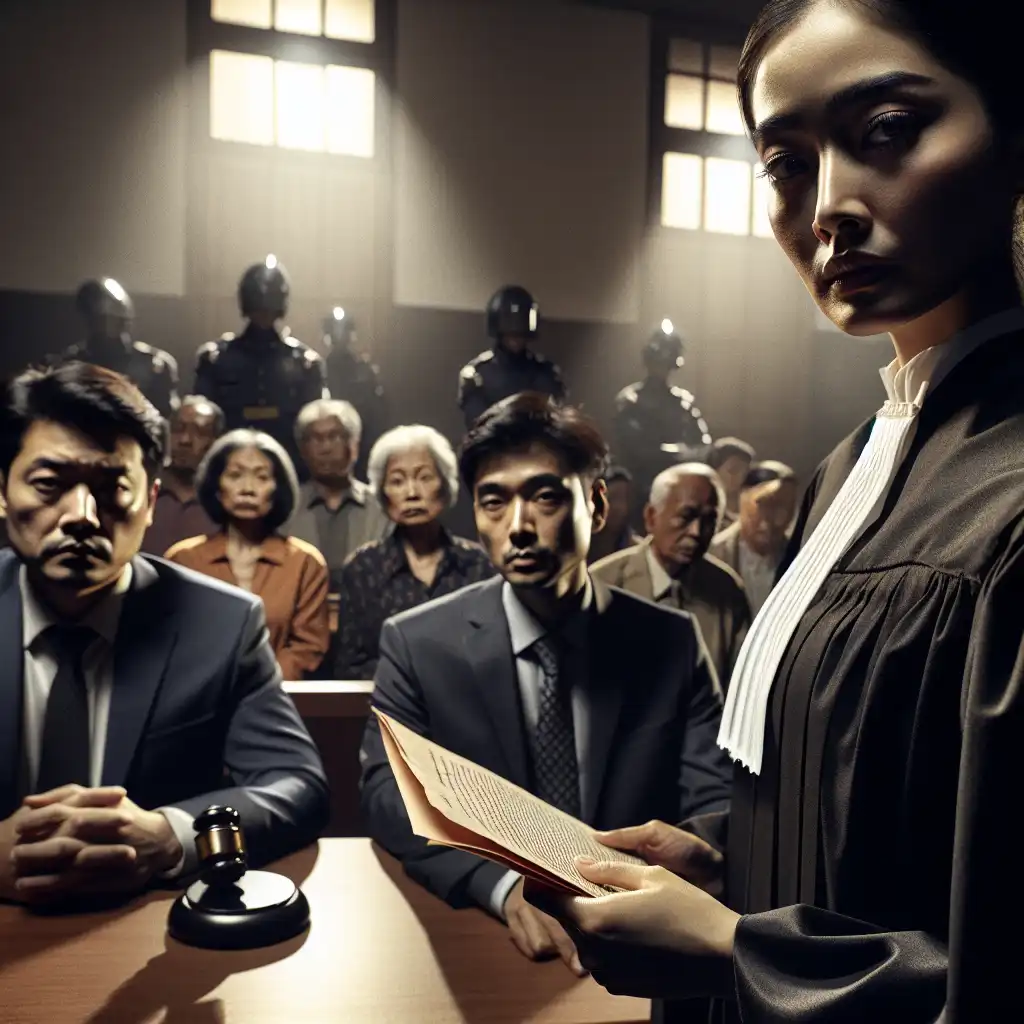
Denouement is a French word meaning 'unraveling' or 'untying'. It is the final part of a story or plot where everything is explained and resolved. Think of it as the end of a mystery movie, where everything is revealed and all loose ends are tied up. It is pronounced DAY-noo-mahnt. So, you can use the word 'denouement' when you want to describe the ending of a story or the resolution of a conflict.
The climax is the point of highest tension or excitement in a story where the conflict or main problem is addressed. It's the most exciting or dramatic part of a story that leads to the resolution.
The climax is applicable towards the middle or end of the story, where the action is at its peak, whereas the denouement takes place at the very end, after the climax has resolved.
Conclusion refers to the ending or outcome of a story or situation. It is applicable when summarizing the main points or events of a story or explaining the final decision or result.
In summary, while both words refer to the end of a story or situation, conclusion is more general and can refer to any type of ending, whereas denouement specifically refers to the final resolution of the plot in a story.
Culmination refers to the highest point or the end result of a process. For example, the culmination of a year-long project would be the final presentation.
It is commonly used in literary contexts. The culmination is used more generally to indicate the end of a process, while denouement is used specifically to describe the resolution of a story.
The term end refers to the conclusion or final part of something. It represents when an event or story reaches its conclusion, and there is no more to come.
It is essentially the final part of the story, where the loose ends are tied up, and the story reaches a satisfying conclusion.
End refers to the concluding point of an event or narrative, while denouement refers to the resolution of the story's conflicts and providing a satisfying conclusion.
Denouement refers to the final outcome or resolution of a story or drama. It's the moment when everything comes together, loose ends are tied up, and the story reaches its conclusion.
Outcome refers to the result or consequence of something. It's the end result or conclusion of an event or action.
The term denouement is more specific to a story or drama, while outcome can refer to any event or action.
Resolution refers to the solving of a problem or conflict within a story. It’s the moment when a character or group of characters overcomes the obstacle or issue that they’ve been struggling with.
To summarize, denouement is the final piece of a story and resolution is the solving of a problem or conflict within a story that happens before the end.
There's a conventional reaction when you see a star: You anticipate he'll be a part of a particular denouement down the road, so you don't worry for that character.
There will, in my view, come a time when there has to be some kind of political denouement inside China, because the newly enriched generation might put up with being told what to do by their rulers - but their children, who will take prosperity for granted, will not.
Plots may be simple or complex, but suspense, and climactic progress from one incident to another, are essential. Every incident in a fictional work should have some bearing on the climax or denouement, and any denouement which is not the inevitable result of the preceding incidents is awkward and unliterary.
The conventional Aristotelian plot proceeds by means of a protagonist, an antagonist, and a series of events comprising a rising action, climax and denouement.
I think the success of 'Downton' is partly because there are effectively 18 leading characters, all given equal importance, so it's enormously involving on many levels. But also, it's a new story. It's not like Dickens or Austen, where everyone knows the denouement.
A brief short story may require only a few paragraphs after the climax. On the other hand, in his massive novel 'The World According to Garp,' John Irving's denouement consisted of 10 separate sections, each devoted to an individual character's fate and each almost a story in itself.
The end of a story must be stronger rather than weaker than the beginning, since it is the end which contains the denouement or culmination and which will leave the strongest impression upon the reader.