
contagion
noun contagion
kənˈteɪdʒən
The spreading of a harmful idea or practice
The contagion of the revolutionary ideas spread to the neighbour countries as well.
contagion
kənˈteɪdʒən
불러오는 중…
kənˈteɪdʒən
The spreading of a harmful idea or practice
The contagion of the revolutionary ideas spread to the neighbour countries as well.
kənˈteɪdʒən
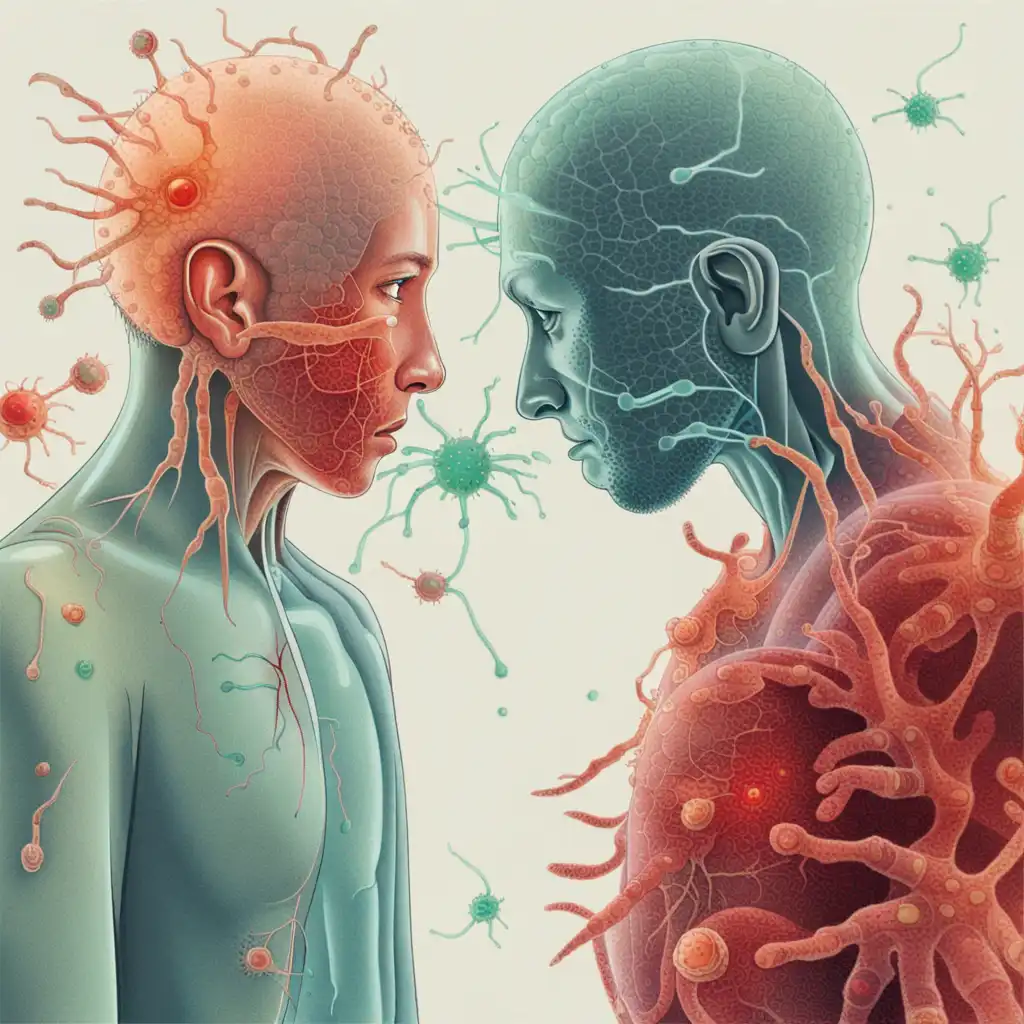
The transmission of a disease from one person or organism to another by direct or indirect contact
In medical context, avoiding physical contact can greatly reduce the risk of contagion.

kənˈteɪdʒən
A disease spread by the close contact of one person to another
The flu is a contagion that is easily spread in crowded places.
오디오를 불러오지 못했어요. 잠시 후 다시 시도해 주세요.
Contagion is a word that is often used to describe the spread of something harmful or negative, like a disease, illness or even a feeling. It is important to understand that it usually has a negative connotation and is used in the context of something spreading that we do not want to happen. For example, if a person has a contagious disease, it means that it can spread to others easily and quickly. We might also use the word to describe the spread of rumors, panic or fear. In general, we use the word to talk about the transmission of something harmful, unwanted or undesirable from one person to another.
Contaminate refers to the presence of harmful or unwanted substances in something. For example, if a drink has been contaminated with bacteria, it could make you sick if you drink it.
Contagion describes the spread of a disease, while contaminate refers to the presence of harmful substances.
단어 열기: Contaminate →Epidemic refers to the widespread outbreak of a disease, affecting a large number of people in a community or region at the same time.
It occurs when the number of infected individuals exceeds the normal or expected level. For example, if a city usually has 10 cases of a disease in a week, but suddenly has 50 cases, that is an epidemic.
In simpler terms, contagion is how a disease spreads, while an epidemic is the result of that spread. Contagion is applicable when discussing the transmission and prevention of a disease, while an epidemic is applicable when discussing the scope and magnitude of a disease outbreak.
단어 열기: Epidemic →Contagion refers to the spread of a disease from one person to another, while infection refers to the invasion and multiplication of a disease-causing organism (like a virus or bacteria) inside the body.
Infection occurs when the disease-causing organism enters the body and starts to multiply. This can lead to a variety of symptoms and can be spread to others through contagion.
Contagion refers to the spread of disease between people or animals, while infection refers to the presence and multiplication of a pathogen within a host organism.
단어 열기: Infection →Outbreak refers to a sudden increase in the number of people infected with a disease in a particular area or population.
Contagion is how a disease spreads, and outbreak is the sudden increase in people infected in a particular area.
단어 열기: Outbreak →Proliferate refers to the rapid growth in numbers or quantity of something.
Contagion relates to the spread of disease while proliferate relates to the growth and multiplication of something.
단어 열기: Proliferate →Propagate means to spread or promote an idea or information.
It can be applicable when talking about the dissemination of news or knowledge, for example, "The scientist propagated her research findings throughout the academic community."
단어 열기: Propagate →Spread is a more general term that can apply to any kind of dissemination or diffusion, such as the spreading of information or the spread of a wildfire.
Spread, in this context, can refer to the overall dissemination of a disease throughout a population, as well as the efforts to contain or mitigate its spread, such as through vaccinations or quarantine measures.
So, in short, contagion refers to the actual transmission of a disease from one person to another, while spread refers to the wider dissemination of the disease through a population and the efforts to control it.
단어 열기: Spread →Transmission refers to the process of moving something or information from one place to another. In the context of a disease, transmission refers to the way a disease is spread through various means such as airborne particles, bodily fluid exchange, contaminated food or water, or animal bites.
Transmission can also refer to the sharing of information or data from one person or device to another. Transmission is applicable in various scenarios, not just related to disease, such as in communication or transportation.
단어 열기: Transmission →then over the next decade, a nationwide effort that ultimately helped topple Poland's communist government. Getting early wins sets in motion a positive feedback loop, a contagion a belief a motivation. It requires pressuring policymakers,
YouTube에서 보기 ↗Our community of contagion really is a world community.
an insecticide treated bed net and you can teach someone to use them. And not only do they protect the people who sleep under them, but they have these great contagion benefits. If half of a community sleeps under a net, the other half also benefits
YouTube에서 보기 ↗Pure truth cannot be assimilated by the crowd; it must be communicated by contagion.
these viruses can rapidly spread and he described often wildlife markets that are selling you know live animals and bush meat are almost cauldrons of contagion you have many different species together in the same place many of these animals are sick many of these
YouTube에서 보기 ↗Virtues, like viruses, have their seasons of contagion. When catastrophe strikes, generosity spikes like a fever. Courage spreads in the face of tyranny.
representation or i may say the equally hapless levels of women at the peace table virtually that has not improved over the last decade and above all the ghastly contagion of rape and sexual violence in so many societies indeed
YouTube에서 보기 ↗Ninety-nine percent of the people in the world are fools and the rest of us are in great danger of contagion.
emissions go up and warm the planet when you look at our maps our results are showing that it's it's it's accelerating it almost looks like a contagion you know it looks like a disease across the planet i mean the
YouTube에서 보기 ↗Our new world rests on order. The danger is disorder. And in today's world, it can now spread like contagion.
That actually is the true nature of the distribution of humor when you don't have the contagion of humor. Humor is a type of entertainment. All entertainment contains a little frisson of danger, something that might happen wrong, and yet we like it when there's protection.
YouTube에서 보기 ↗War is a contagion.
and some of them were really very helpful for my parents. Some of them were really afraid of contagion, and they wouldn't even walk in front of our house. They would literally walk across the street.
YouTube에서 보기 ↗He who is the author of a war lets loose the whole contagion of hell and opens a vein that bleeds a nation to death.
And I said "Everywhere else in the world, that's normal human behavior." And so there's a very instinctive way in which we briefly transmit emotions to each other. And in fact emotional contagion can be broader still. Like we could have punctuated expressions of anger, as in riots.
YouTube에서 보기 ↗As contagion of sickness makes sickness, contagion of trust can make trust.
She left. And if you know anything about rural India, you'll know that's an unspeakably courageous thing to do. But not just that. She got her toilet and now she goes around all the other villages in India persuading other women to do the same thing. It's what I call social contagion and it's really powerful
YouTube에서 보기 ↗Contagion has become very much a phenomenon, and it's a phenomenon of globalization.
and also just to the contagion of the idea of freedom you know. If women spend nine months being pregnant and caring for a child, why isn't it that men are responsible for spending that much more than half the time
YouTube에서 보기 ↗Even if the Brits decide to remain, we will have to avoid a contagion on other countries.