combustion
noun combustion
kəmˈbʌstʃən
The process of burning something
The combustion of coal produces a great deal of smoke
combustion
kəmˈbʌstʃən
Chargement…
kəmˈbʌstʃən
The process of burning something
The combustion of coal produces a great deal of smoke
kəmˈbʌstʃən
Chemical process when a substance reacts with oxygen to give heat and light
Carbon combustion in the atmosphere is causing global warming.
kəmˈbʌstʃən
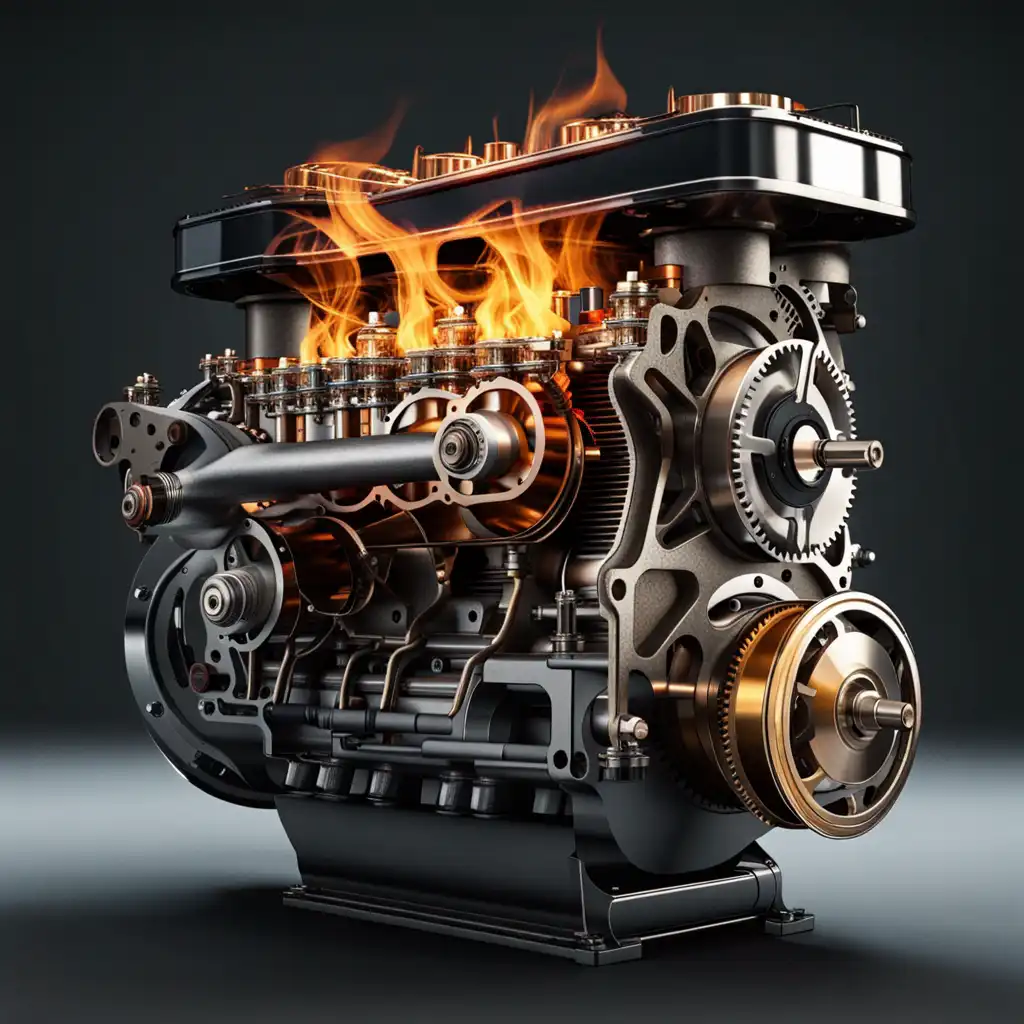
The process in a combustion engine that produces movement
In an internal combustion engine, fuel is burned in the engine to produce power.
Impossible de charger l’audio. Réessayez plus tard.
The word 'combustion' refers to the process in which a substance reacts with oxygen to produce energy. It is often used in the context of burning fuels to generate heat and power, such as in the engines of cars or power plants. As an English learner, it is important to understand the meaning of this word in order to comprehend discussions about energy and the environment.
Blaze refers to a flame or fire that is very visible and usually produces a lot of heat and light. It's often used to describe a fire that is out of control, like a forest fire or a house fire.
Blaze refers to a visible flame while combustion refers to a chemical reaction that produces heat and light.
Ouvrir le mot: Blaze →Burn is a term used generally to describe a reaction where there is a release of heat, light, and often smoke. This reaction involves the interaction between two or more substances and a fuel source, such as oxygen.
Burning occurs at relatively low temperatures and can happen naturally, such as during a forest fire, or can be intentionally induced, such as when lighting a candle.
This reaction occurs between a fuel source, an oxidizing agent, and heat (activation energy). Combustion occurs at high temperatures, and it is typically a more controlled and intense reaction than burning.
In summary, 'burning' is a general term used to describe a reaction between substances while combustion is a specific scientific term used to describe the reaction between fuel, oxidizing agent, and heat.
Burning can occur naturally or intentionally, while combustion typically occurs in engines and is a more controlled and intense reaction.
Ouvrir le mot: Burn →Fire is a physical manifestation of combustion that occurs when there is a sustained reaction between fuel and heat.
Fires produce heat, light, and smoke, and can result in significant damage, injury, or death.
It can happen naturally, such as wildfires, or can be deliberately set, like in fireplaces or campfires.
Combustion is a chemical process, while fire is the physical manifestation of that process. Combustion happens in engines or industrial machinery, while fire can happen naturally or be deliberately set in specific locations.
Ouvrir le mot: Fire →Combustion refers to a chemical reaction that occurs when a fuel, such as gasoline or wood, reacts with oxygen. This reaction produces heat and light energy, and it can happen without flames.
Flame is the visible part of combustion, where the hot gases produced by the reaction are glowing and emitting light. Flames are typically seen in situations where there is a lot of oxygen available to support combustion, such as in a gas stove or a campfire.
Combustion is the chemical reaction that occurs when a fuel burns, while a flame is the visible result of the reaction.
Combustion can happen without flames, but flames usually indicate that combustion is taking place.
Ouvrir le mot: Flame →Both combustion and ignite relate to fire but they have different meanings. Combustion refers to the process of burning something completely, typically in the presence of oxygen, to release energy.
Ignite means to start a fire or combustion process. It refers to the moment when a flame or spark is introduced to a flammable substance, causing it to catch fire.
Combustion is the actual process of burning something while ignite is the moment of starting the process. Combustion describes fires on a larger scale while ignite describes the moment of ignition or starting a fire.
Ouvrir le mot: Ignite →Incinerate refers to the deliberate burning of something to destroy it or reduce its volume.
It is typically used to dispose of waste, such as medical or hazardous materials. Incineration is usually done at very high temperatures in special facilities designed for this purpose.
Combustion is a natural or intentional process of burning something while incineration is the deliberate burning of something to dispose of it.
Ouvrir le mot: Incinerate →Oxidation is a broad term used to describe any chemical reaction where a substance loses electrons to another substance, often oxygen.
In essence, combustion is a specific type of oxidation that produces heat and light, while oxidation can occur without producing these effects.
Both of these concepts are important in understanding various chemical reactions in everyday life, particularly those involving combustion engines and the deterioration of materials due to oxidation.
Ouvrir le mot: Oxidation →Combustion is a specific type of reaction that involves the rapid burning of a substance, usually with the release of heat and light.
A reaction is a general term for any process that results in a chemical change.
Reactions can involve the breaking and making of chemical bonds, and can occur with or without the release of energy.
Many chemical reactions, such as those involved in photosynthesis or respiration, occur at a slower rate than combustion and do not involve flames.
So, while combustion is a specific type of reaction that involves burning and the release of heat and light, reactions can refer to a wide variety of chemical processes.
Ouvrir le mot: Reaction →Your match adds enough energy to activate the exothermic reaction of combustion, converting the high-energy combustible material in the wood to lower energy carbon dioxide and water. Entropy also increases and helps the reaction along
Voir sur YouTube ↗I think the likelihood that combustion will continue to represent the large portion of the power unit world is very small.
is slow and hard to understand and hard to use. Digital money like the horse and carriage, works pretty well, and the whole world economy is built on it. If you were the first person on your block to get a car with an internal combustion engine,
Voir sur YouTube ↗The cars haven't advanced that much since we were kids. When you boil it down, it's still a gas combustion engine.
remodify them and give them a chimney, and design them in a way that limits the amount of oxygen that goes into the combustion process. We go back to the villages, find farmers with the help of local leaders, train these farmers how to use these kilns,
Voir sur YouTube ↗Spontaneous combustion of grassroots politics is the future.
clear the natural history including climates or subsets of fire history this new combustion burns without the old ecological checks-and-balances burns day
Voir sur YouTube ↗The way plays happen, at least with me, it's spontaneous combustion of things you've had in your head.
But combustion is an exothermic reaction meaning it releases heat. Lots of it. And while much of this heat escapes through the tail pipe, the heat that remains in the engine block needs to be absorbed transported and dissipated to protect the metal components from deforming or even melting. This is where the cooling system comes in.
Voir sur YouTube ↗I think the internal combustion engine will disappear from the streets of our cities in the next thirty years because transportation will be mass transportation, or probably electrical power.
As the fire heats up the carbon dioxide and water vapor created by combustion expand. Now that they’re less dense they rise in a thinning column. Gravity causes this expansion and rising which gives flames their characteristic taper.
Voir sur YouTube ↗Electromagnetic theory and experiment gave us the telephone, radio, TV, computers, and made the internal combustion engine practical - thus, the car and airplane, leading inevitably to the rocket and outer-space exploration.
At the same time oil discoveries lowered the price of gasoline, and new advances made internal combustion engines more appealing. Electric starters removed the need for hand-cranking, mufflers made engines quieter and rubber engine mounts reduced vibration.
Voir sur YouTube ↗My earliest memory of cooking is my grandmother showing me how to make chicken gravy on the big combustion stove in her kitchen. I still use Nana's gravy recipe.
Something else to consider is that overcoming friction takes energy, so you're losing energy to friction. This is one way your tires can influence your fuel efficiency. And in fact did you know that about one-third of the fuel that you put into your internal combustion engine vehicle
Voir sur YouTube ↗An e-cigarette does not function in manner of a traditional cigarette because it functions electrically rather than via combustion of a material such as tobacco.
combustion engine vehicles. One fish is just one fish in the sea. And one cup of coffee doesn't amount to a hill of beans in this crazy world. But we do these things because we believe they matter, that our actions add up,
Voir sur YouTube ↗The advent of ebooks is no more going to kill the pleasure of reading than the introduction of the internal combustion engine made horses extinct.
there are some 45 jurisdictions around the world -- national regional and municipal -- where laws have been passed beginning a phaseout of internal combustion engines.
Voir sur YouTube ↗The human relationship to combustion is as mysterious as it is fraught with madness. From the candle flame to the nuclear blast, it has lit up the human imagination with fear and fascination.