
singe
verb singe
sɪndʒ
To burn lightly on the surface, not deeply, making it discolored or damaged.
I accidentally singed my hair while lighting the candle.
singe
sɪndʒ
Cargando…
sɪndʒ
To burn lightly on the surface, not deeply, making it discolored or damaged.
I accidentally singed my hair while lighting the candle.
sɪndʒ
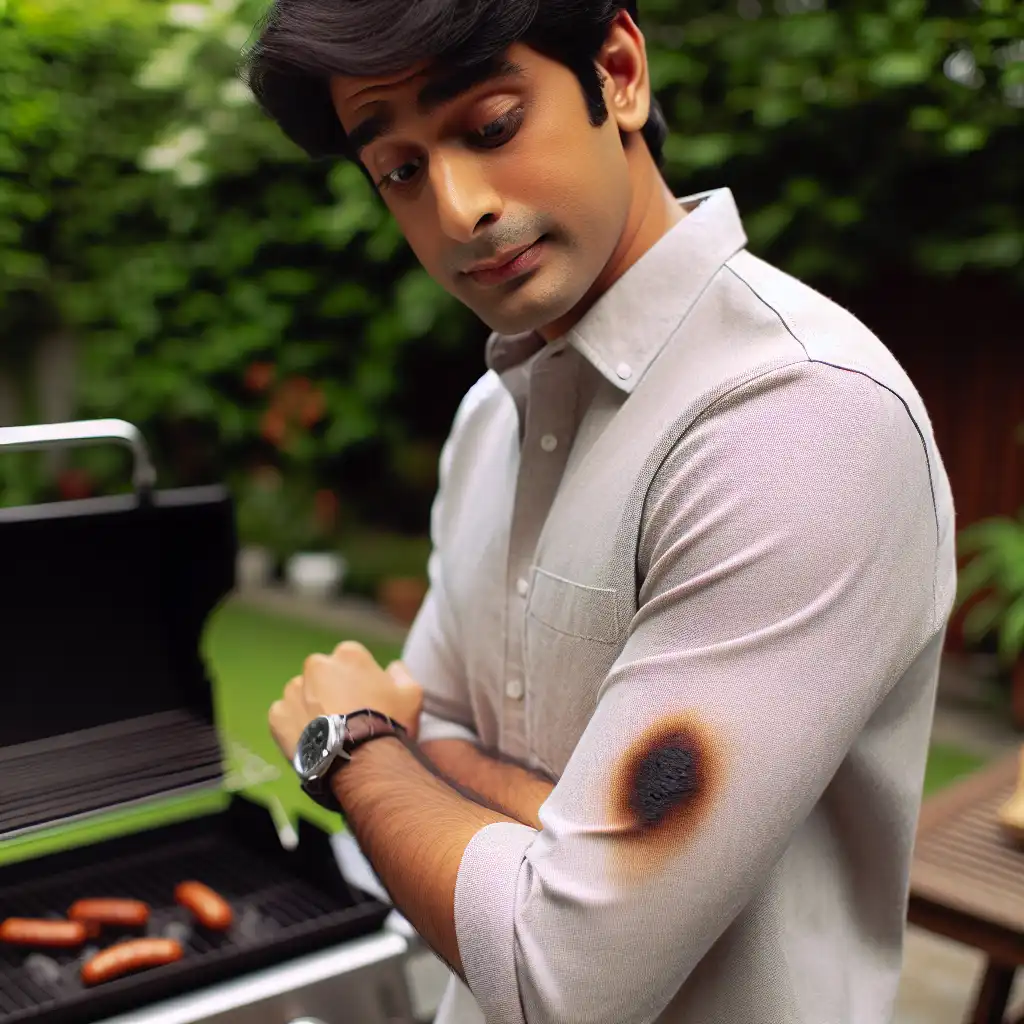
A light burn or discoloring caused by slight burning
He got a singe on the sleeve of his shirt from the barbecue.
No se pudo cargar el audio. Inténtalo de nuevo más tarde.
The word 'singe' means to burn something lightly, quickly and briefly. You can use it to describe accidentally burning your hair or clothes with a lighter, candle or stove. It can also describe burning off the feathers, fur or hair of an animal before cooking it.
Blast means to hit or strike something hard or to explode with a destructive force.
Blast is a more severe and destructive action, while singe is a lighter and less harmful one. Blast is applicable when there is a need to describe something that produces destruction or damage or a significant impact while singe is used in situations where something gets burned, but the burning isn't enough to cause harm.
Abrir palabra: Blast →Burn is used when something is heated to the point of being destroyed, blackened or charred. It's often used to refer to things that are on fire, like when a building or a piece of paper is burning.
Singe is used to refer to something that's been briefly exposed to heat and has become slightly burnt or browned. It's often used to refer to hair, where you might singe the ends of your hair with a lighter or straightening iron to give it a particular style.
The key differences between burn and singe are the degree and duration of the heat exposure. You would use the word burn for something that has been subjected to intense heat and has been damaged or changed irreparably, whereas singe is used for something that has been briefly exposed to heat but isn't necessarily destroyed or ruined.
Abrir palabra: Burn →Char means to burn something until it turns black, usually in a controlled way (like cooking a marshmallow).
Char is applicable when intentionally cooking something, while singe is applicable when something is accidentally burned.
Abrir palabra: Char →Flame is the visible, burning gas that comes from a fire, while singe means to burn the edges or surface of something without setting it on fire.
Flame is applicable when a fire produces a visible, hot gas that can light up an area or cause damage. Singe is applicable when something is burned lightly or its surface is scorched.
For example, if you hold a piece of paper too close to a flame, it will catch fire and burn completely, but if you hold it close enough to singe the edges, it will only have a burnt smell and remain intact.
Abrir palabra: Flame →Scorch means to burn the surface of something with intense heat, leaving it discolored or blackened. This usually happens when there is direct contact between the object and the source of heat, like putting a pan too close to a hot stove.
Scorch implies a more intense burning with visible damage, while singe implies a lighter burning without as much damage.
Abrir palabra: Scorch →Searing is the process of cooking something very quickly at a very high temperature to give it a crispy or browned crust. This method is often used for meat or fish.
In summary, searing is used for cooking while singeing is used for removing unwanted materials.
Abrir palabra: Sear →The words singe and toast both refer to cooking or heating food, but they are different in how they are done and which foods they are used for.
Toast means to cook or brown something by exposing it to heat, usually in a dry environment like a toaster or an oven.
It is often used for bread or other baked goods to make them crusty and crunchy. To toast something, you would put it in a toaster or oven and let the heat brown the surface.
Singe is used for cooking meats with an open flame, while toast is used for browning baked goods with heat in a dry environment like a toaster or oven.
Abrir palabra: Toast →Torch refers to the act of burning something more extensively with the intention of causing damage or destruction. For example, if someone were to intentionally set fire to a building or a pile of leaves, they would be torching it.
Singe refers to a small and controlled burn, while torch refers to a larger and more destructive burn.
Abrir palabra: Torch →We Are What We Eat:...
Ver en YouTube ↗Heat not a furnace for your foe so hot that it do singe yourself.
The myth of Jason,...
Ver en YouTube ↗I think there's something in the human psyche that we're titillated by the person who flies too close to the candle and their wings get singed.
You have no idea where...
Ver en YouTube ↗I don't believe anyone should ignore all the fires around you and stand pat and not worry about getting singed.
We Are What We Eat:...
Ver en YouTube ↗Ms. Sciorra is a member of a dwindling fleet of actors who actually sound like they come from somewhere. In her case, 'somewhere' is Brooklyn. In most movies, and perhaps especially in a handful of singeing 'Sopranos' episodes, 'somewhere' makes her vital. She's what you'd call an around-the-way girl.
An interview with the...
Ver en YouTube ↗When I singed 'Love Dose' with Yo Yo Honey Singh, I heard the song and got hooked to it.
Eating Bats %\PIPE% National...
Ver en YouTube ↗For my wife Mary Corliss and me, 'Colbert' has been destination viewing. Even in the early years, we never took the show's excellence for granted, agreeing that someday we'd look back on the double whammy of 'The Daily Show' and 'The Colbert Report' as the golden age of TV's singeing singing satire.
Rachel Sussman: The...
Ver en YouTube ↗Horses vs. Horsepower:...
Ver en YouTube ↗Safari Live - Day 190 %\PIPE%...
Ver en YouTube ↗John Wesley Powell: From...
Ver en YouTube ↗