
diffusion
noun diffusion
dɪˈfjuːʒn
The spreading out of something in all directions or into a new area
The diffusion of knowledge from universities to the industry has increased over the past decade.
diffusion
dɪˈfjuːʒn
Loading…
dɪˈfjuːʒn
The spreading out of something in all directions or into a new area
The diffusion of knowledge from universities to the industry has increased over the past decade.
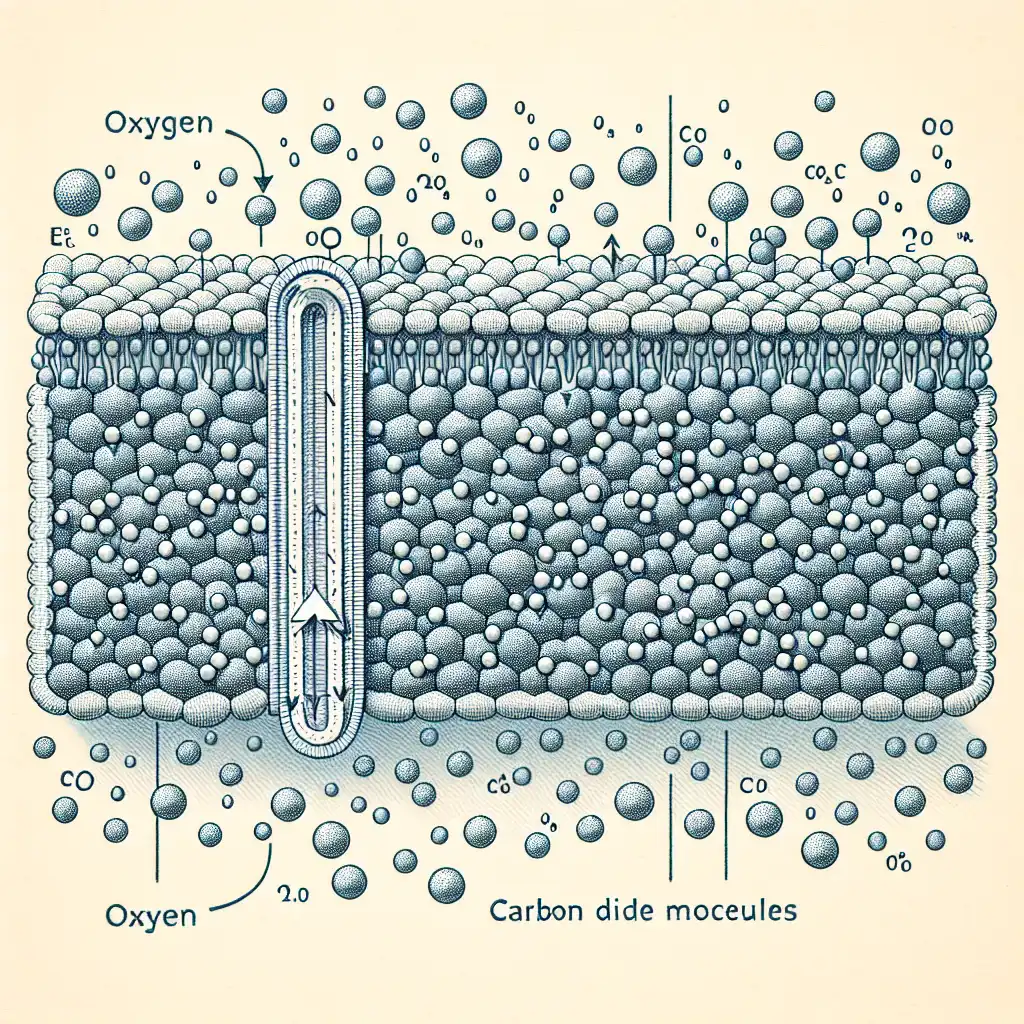
dɪˈfjuːʒn
The movement of particles from an area of high concentration to an area of low concentration
Oxygen and carbon dioxide move across the cell membrane by diffusion.

dɪˈfjuːʒn
The interaction of cultures, ideas, or beliefs leading to their becoming more alike or mixed
The Internet has massively boosted the diffusion of Western culture across the globe.

dɪˈfjuːʒn
The way of spreading the light of a light source evenly so as to reduce glare and harsh shadows.
The photographer used a diffuser to create a soft lighting effect through diffusion.
Audio could not be loaded. Please try again later.
Diffusion is a way of describing how things spread out or move around in different places. For example, when you spray perfume in one corner of a room, the smell will eventually spread to other parts of the room because of diffusion. Another example is how a drop of food coloring added to water will eventually spread out evenly throughout the entire water because of diffusion. So, diffusion is a process of spreading out like in gases, liquids or even solids.
Circulation and diffusion are two different processes that apply to different things. Circulation usually refers to the movement of fluids, gases, or blood through a closed system, like a circulatory system or the circulation of air in a room.
In simpler terms, circulation is like a loop where a substance moves around in a closed system, while diffusion is more like a spreading out of particles from where they are concentrated to where they are sparse.
Open word: Circulation →Dispersion refers to the distribution of particles throughout a medium.
Diffusion refers to the movement of particles from high concentration to low concentration, while dispersion refers to the distribution of particles throughout a medium.
Open word: Dispersion →Disseminate refers to the act of distributing or sharing information, ideas, or knowledge to a wider audience. For example, disseminating scientific findings to the public.
Diffusion describes the spread of something physical, while disseminate describes the spread of something non-physical like information.
Open word: Disseminate →Penetrate refers to the process of getting through or breaking through something.
It usually describes the movement of an object, substance, or even an idea through a barrier or obstacle. For example, a nail can penetrate wood, water can penetrate soil, and an idea can penetrate someone's mind.
Diffusion is about spreading something out, while penetration is about getting through something. Diffusion is typically used to describe the movement of substances, while penetration is typically used to describe the movement of objects or ideas.
Open word: Penetrate →Permeate refers to the process where a substance passes through a membrane, such as water molecules passing through a coffee filter.
Permeation requires an external force or a concentration gradient on either side of the membrane to push the substance through.
In simpler terms, diffusion is the movement of particles from a crowded area to a less crowded area, while permeation is the movement of substances through a membrane.
Diffusion can happen anywhere in nature without any external force, while permeation requires an external force to push the substance through a barrier.
Open word: Permeate →Propagate refers to the spreading or transmission of something, such as information, disease, or sound waves.
This process involves a force or energy that causes the thing to spread. An example of propagation would be the transmission of a virus from one person to another.
Diffusion refers to the movement of particles without an external force, while propagation involves the spreading of something through a force or energy.
Open word: Propagate →Diffusion refers to the process of molecules or particles spreading evenly throughout a medium or across a barrier, such as the diffusion of perfume molecules in a room.
Spread can have a similar meaning but is often used more generally to refer to the expansion or distribution of something, such as the spread of a disease, the spread of wildfire, or the spread of news.
While diffusion is typically used in a scientific context, spread can be used in a variety of contexts.
Open word: Spread →Diffusion and transmission are two different ways of describing the way something moves from one place to another.
Transmission usually refers to the deliberate or unintentional movement of something from one place to another. For example, when you catch a cold from someone else, the virus is transmitted from their body to yours through contact, coughing or sneezing.
To summarize, diffusion is a natural process of particles or molecules spreading out, while transmission usually involves an external force and the intentional or unintentional movement of something from one place to another.
Open word: Transmission →Oxygen’s surprisingly...
Watch on YouTube ↗The advancement and diffusion of knowledge is the only guardian of true liberty.
How great leaders...
Watch on YouTube ↗To maximise global social welfare, policymakers should strongly encourage the diffusion of knowledge from developed to developing countries.
The Making of the...
Watch on YouTube ↗The progress of freedom depends more upon the maintenance of peace, the spread of commerce, and the diffusion of education, than upon the labors of cabinets and foreign offices.
Gastronomy and the...
Watch on YouTube ↗The world is not going into concentric blocs of power. It is actually going into a diffusion of power with more centres of decision-making than ever in human civilisation. That requires you to place yourself in far more hubs of power than ever before.
At what moment are you...
Watch on YouTube ↗Innumerable spirits and souls, when spread out through the same space, do not interfere with each other such that the diffusion of one would affect the diffusion of an infinity of others.
What yoga does to your...
Watch on YouTube ↗The ancient codes were doubtless originally suggested by the discovery and diffusion of the art of writing.
How we can protect truth...
Watch on YouTube ↗The widespread diffusion of nuclear weapons would make many nations able, and in some cases also create the pressure, to aggravate an on-going crisis, or even touch off a war between two other powers for purposes of their own.
Joseph Nye on global...
Watch on YouTube ↗Every one must understand that, whatever be the evil of slavery, it is not increased by its diffusion. Every one familiar with it knows that it is in proportion to its sparseness that it becomes less objectionable. Wherever there is an immediate connexion between the master and slave, whatever there is of harshness in the system is diminished.
Geoffrey West: The...
Watch on YouTube ↗The main force pushing toward reduction in inequality has always been the diffusion of knowledge and the diffusion of education.
How great leaders...
Watch on YouTube ↗In a large mass of muscle deprived of its circulation, the rate at which the recovery process can go on, after severe stimulation, depends on the rate at which oxygen can reach the fibres by diffusion.