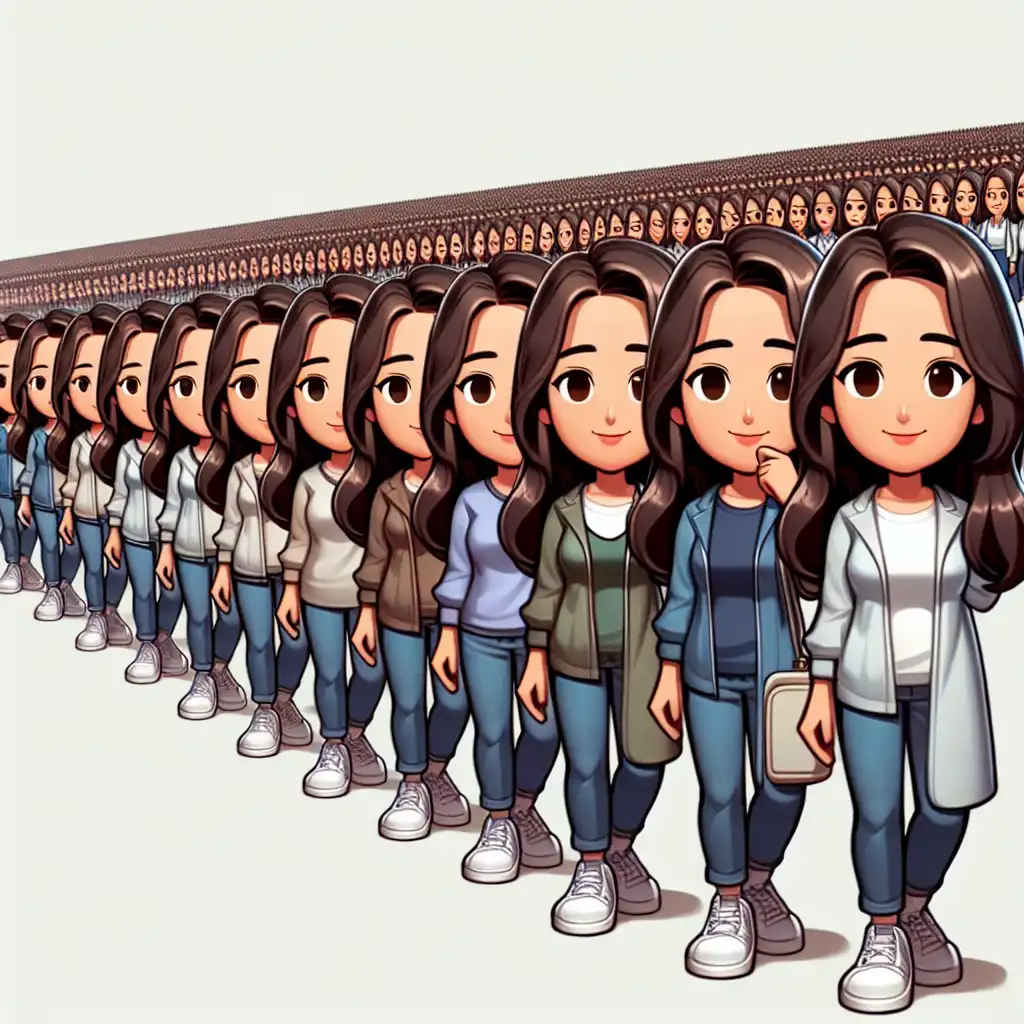
homogeneity
noun homogeneity
ˌhəʊməʊdʒəˈniːəti
The quality of being similar or the same
The homogeneity of the group made it hard to single out anyone.
homogeneity
ˌhəʊməʊdʒəˈniːəti
加载中…
ˌhəʊməʊdʒəˈniːəti
The quality of being similar or the same
The homogeneity of the group made it hard to single out anyone.

ˌhəʊməʊdʒəˈniːəti
The condition of having a uniform composition throughout
The homogeneity of the sample was confirmed through testing.

ˌhəʊməʊdʒəˈniːəti
The state of being similar in nature, character or appearance
The homogeneity of the trademarks led to a legal dispute.
音频无法加载,请稍后再试。
Homogeneity is a big word that people use to talk about things that are the same. It means that things have a similar quality or are all alike. For example, if you go to a place where everyone has the same skin color, hair color, and speaks the same language, you might say that the people in that place have homogeneity. Or, if you look at a salad and all the vegetables are the same size and color, you might say it has homogeneity. The word is often used in science or statistics to talk about the sameness of a sample or population. For instance, if a scientist is studying a group of cells and they all have the same traits, they might say they are homogeneous.
Consistency refers to how the parts of something are similar to each other and stay the same over time. For example, a cake batter should have consistency - it should have the same texture and thickness throughout.
Both consistency and homogeneity refer to how things are uniform or the same, but consistency focuses on the nature of the parts while homogeneity focuses on the entire thing or mixture.
They are both important in different contexts, for example, consistency is important in baking and cooking, while homogeneity is important in chemistry and physics.
打开单词: Consistency →Equality refers to the state of being equal or having the same rights, opportunities, and treatment regardless of differences in race, gender, disability, etc.
In simpler terms, equality is about treating people fairly and justly, regardless of their differences, while homogeneity is about things being the same or uniform in nature.
打开单词: Equality →Identity refers to the distinguishing characteristics of a person or group, such as their personality, beliefs, and values.
Homogeneity is applicable when referring to things that are the same or similar, such as a group or population. Identity is applicable when referring to a person's or group's individuality and uniqueness, such as their personal characteristics or cultural background.
Homogeneity means being the same while identity means being unique.
打开单词: Identity →Regular generally means something that follows a pattern or conforms to a set of rules.
It can also refer to something that occurs at predictable intervals. For example, a regular workout routine or a regular paycheck.
Homogeneity refers to consistency within a group, whereas regularity refers to adherence to a pattern or schedule.
打开单词: Regular →Homogeneity refers to a state of being uniform or consistent in nature, whereas the word same refers to something identical or similar in nature.
Homogeneity emphasizes a state of similarity or uniformity in a group or population, while same emphasizes the exactness or similarity between individual items or objects.
An example of homogeneity would be a group of people who share the same cultural identity, while an example of same would be two identical twins.
Homogeneity is applicable in fields such as statistics and biology, while same can be used in everyday language.
打开单词: Same →Similarity refers to the state of having common features, characteristics or qualities.
In other words, two or more things have some things in common, but they can still have some differences between them. For example, if you have two different types of fruit, like an apple and an orange, you could say they have some similarities, like being round and a fruit, but they are not homogenous.
Homogeneity relates to things being identical or very alike, while similarity means that there are some shared characteristics but differences still exist.
打开单词: Similarity →Symmetry refers to having a balanced or corresponding arrangement of parts. For example, a butterfly has symmetry because each of its wings is mirror-image of the other.
However, homogeneity is more commonly used in fields like chemistry and physics, while symmetry is often used in geometry and design.
打开单词: Symmetry →Uniformity refers to a state of being the same in form, appearance, or character. It is about having a consistent or standardized look or behavior.
Uniformity is applicable in contexts such as military or law enforcement where a consistent appearance or behavior is necessary for identification and discipline, or in manufacturing where standardized products are important for quality control.
打开单词: Uniformity →Ami Klin: A new way to...
在 YouTube 上观看 ↗There is no consensus, there is no homogeneity, there is no truth.
A new way to diagnose...
在 YouTube 上观看 ↗I continue to believe, contrary to the given wisdom, that it's more interesting to have an album - or, indeed, an individual song - which has variety rather than homogeneity.
When I speak of 'cycles,' I am referring to lengthy intervals of relative homogeneity, if not in the resolving of problems, than at least with respect to the consistency of their capacity to productively irritate.
The great western error about the Taliban is to assume homogeneity.
We demand that people should be true to the pictures we have of them, no matter how repulsive those pictures may be: we prefer the true portrait in all its homogeneity, to one with a detail added which refuses to fit in.
The existence of symmetry laws is in full accordance with our daily experience. The simplest of these symmetries, the isotropy and homogeneity of space, are concepts that date back to the early history of human thought.
To increase the power, develop the resources and promote the happiness of a Confederacy, it is requisite there should be so much of homogeneity that the welfare of every portion would be the aim of the whole.
Nonetheless, we continue to be obsessed with finding or inventing a European nation which, as in the nation state, guarantees homogeneity and thus an appropriate form of democracy and centralized government.
Most cities are eclectic. There's a bit of medieval, Georgian, some Victorian and some 20th century. That's fine. Bath is different because it was built within 100 years or less. It has a homogeneity.
Civilization is a progress from an indefinite, incoherent homogeneity toward a definite, coherent heterogeneity.