congeal
verb congeal
kənˈdʒiːl
To change from a liquid or soft state to a thick or solid state.
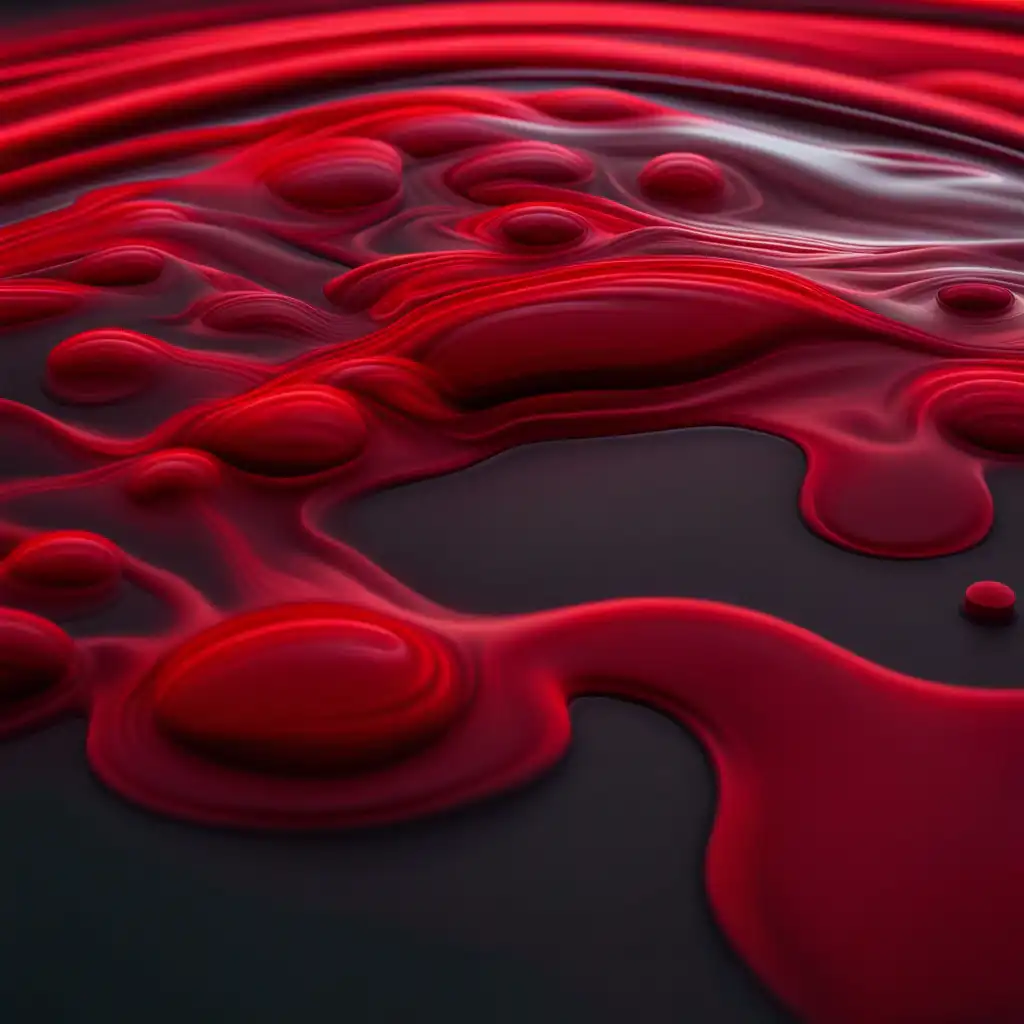
The blood had started to congeal.
congeal
kənˈdʒiːl
Chargement…
kənˈdʒiːl
To change from a liquid or soft state to a thick or solid state.
The blood had started to congeal.

kənˈdʒiːl
To become fixed, stuck, or unchangeable, often in a bad situation or state.
His ideas had congealed and he was unable to think of anything new.
Impossible de charger l’audio. Réessayez plus tard.
The word 'congeal' means to solidify or become thick and sticky, usually referring to liquids such as blood, soup, or jelly. It can also refer to something becoming rigid or unchanging, for example, a friendship that has congealed into bitterness. You can use this word when describing the state of certain substances, such as when gravy starts to congeal after it has been left out for too long. It can also be used metaphorically when describing emotions or feelings that have become stagnant or stuck in a negative way.
Clot refers to the process of blood turning from a liquid to a semi-solid state, which can happen naturally when a person is injured.
Clot is mainly used in medical contexts, while congeal can be used in a wide range of everyday situations - e.g. "the soup has congealed in the fridge", "the sauce is starting to congeal on the plate".
Clot is specific to blood coagulation, while congeal refers to the solidification of any liquid or substance.
Ouvrir le mot: Clot →The words coagulate and congeal both refer to the process of a liquid turning into a solid.
Coagulate is typically used when referring to blood or other bodily fluids. It means that the liquid has thickened and clumped together to form a gel-like substance.
For example, when a person gets a cut, their blood will begin to coagulate to form a scab.
Coagulate is used when referring to bodily fluids, while congeal is a general term that can be used for any liquid that solidifies.
Ouvrir le mot: Coagulate →Both congeal and curdle refer to the process in which a liquid turns into a solid or thickens.
However, congeal is usually used when a liquid thickens or solidifies by cooling, while curdle is used when a liquid thickens or solidifies due to a chemical reaction or souring.
For example, Jell-O congeals when it is refrigerated while milk curdles when it is left out at room temperature for too long or mixed with an acid like lemon juice.
Ouvrir le mot: Curdle →Freeze means to become solid, typically due to the lowering of temperature. It applies to things like water turning into ice when it gets cold.
Congeal is when a liquid turns into a soft or jelly-like solid, while freeze is when a liquid turns into a hard, icy solid.
Ouvrir le mot: Freeze →Gel refers to something that has already solidified and has a jelly-like consistency. It's often used to describe products like hair gel or hand sanitizer.
Congeal is the process of something becoming solid, while gel is the resulting solid substance.
Ouvrir le mot: Gel →The words congeal and solidify both mean to change from a liquid to a solid form.
Solidify describes a change from a liquid to a solid state, such as water freezing into ice.
Congeal refers to the thickening of a liquid, while solidify refers to the complete change of a liquid to a solid state.
Ouvrir le mot: Solidify →Stiffen refers to something becoming less flexible or more rigid.
Congeal is used when describing a liquid turning into a solid, while stiffen refers to something becoming more rigid or inflexible.
Ouvrir le mot: Stiffen →Congeal and thicken both refer to substances becoming denser or more solid, but there is a slight difference in their usage.
Thicken typically refers to substances becoming more viscous or dense without necessarily turning solid, and is often achieved through the addition of a thickening agent such as flour or cornstarch.
So if you add flour to a gravy to make it more dense and creamy, you could say that you have 'thickened' it. Congeal implies a more solid state resulting from natural processes, while thicken implies a more viscous or dense consistency through added agents.
Ouvrir le mot: Thicken →Samantha Power: Shaking...
Voir sur YouTube ↗We build our technologies as a way of addressing all our anxieties and desires. They are our passions congealed into these prosthetic extensions of ourselves. And they do it in a way that reflects what we dream ourselves capable of doing.
The history of our world...
Voir sur YouTube ↗Congealed fat is pretty much the same, irrespective of the delicacy around which it is concealed.
The museums and parks are graveyards above the ground- congealed memories of the past that act as a pretext for reality.
I was an avid reader as a child. I am losing that habit now, as my brain congeals into cabbage from wearing too many heels and too much foundation.
I once set myself a deadline: half a chapter a week, 20 minutes a day. The thought froze me instantly, like literary Botox. I returned to my non-schedule: sleeping, writing 20 minutes, and then back to sleep. Breakfast in bed, with juice congealing on the sill: pages and pages began to pour out again.
It was a very strange time in the late 1950s/early 1960s, when people were putting things in space, but that language of spacecraft hadn't really congealed yet. A lot of artists at that time were looking at them as aesthetic objects.